


On October 2, 2009, then-Governor Jodi Rell issued Executive Order 27-A, which limited the number of days retired state employees could work when temporarily rehired by state agencies. The order remains in effect today and stipulates that rehires can work only 120 days, or 960 hours in a calendar year. The Executive Order also stipulates that “No more than two 120-day periods may be approved under the program for an individual retiree.” Rell’s order intended to disincentivize “double-dipping,” where an employee retires early to collect their pension and health benefits while still being paid a salary.
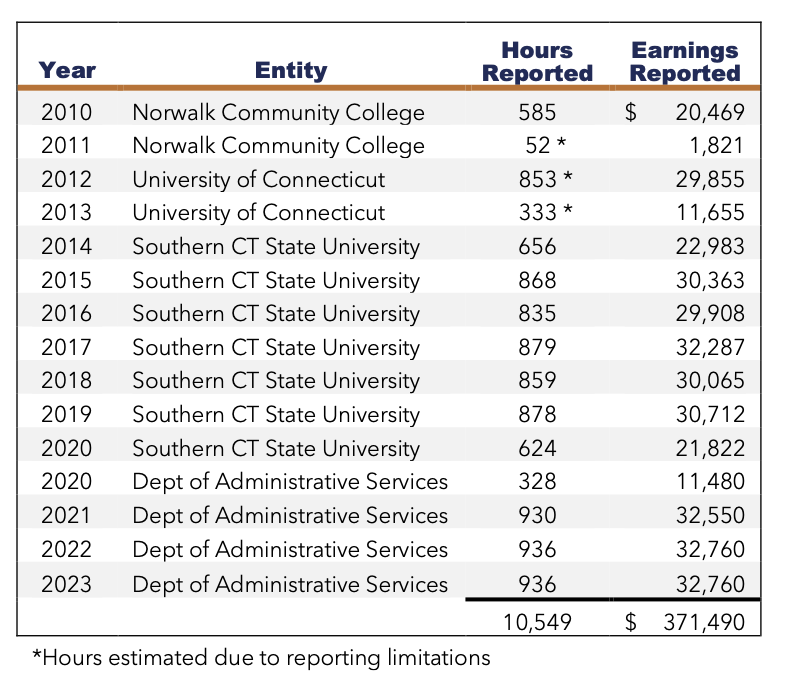
Buried among the 24 findings and 63 pages of the Auditors of Public Accounts’ (APA) latest report on the Department of Administrative Services (DAS) was the discovery of a rehired retiree who accrued over 10,000 hours over 13 years and earned approximately $371,490 in total.
“Rehired retirees are able to work in state positions in excess of established limits while collecting state positions,” the auditors wrote. “The Department of Administrative Services should establish controls to ensure compliance with Executive Order Number 27-A.”
The auditors found DAS employed 21 rehired retirees at the time of their report, which examined DAS during fiscal year 2021-2022. The employee in question worked for numerous state colleges — for Norwalk Community College in 2010 and 2011, for UConn in 2012 and 2013, and for SCSU from 2014 to 2020 — before working directly for DAS from 2020 to 2023. The employee recorded the most working hours in 2022 and 2023; in both years, they worked 936 hours, earning $32,760.
While the auditors acknowledged that DAS officials complied with the 960-hour cap, they determined that departmental procedures “do not consider the two 120-day term limit in their design.” The auditors also noted that this was a novel finding, not reported in previous years’ audits.
“We agree with the findings, as this was an oversight,” admitted DAS in the agency response section. “We will work on a standard operating procedure for establishing controls to confirm whether a retiree has already served as a retiree prior to hiring as well as for time monitoring.”
Per their response, DAS officials also noted that the agency received approval from the Governor’s Office through fiscal year 2023 for the employee. Rell’s executive order requires agencies to receive approval from the DAS Commissioner, the Secretary of the Office of Policy and Management, and the Governor’s Office before rehiring retirees.
“The department obtained approval from the Office of the Governor,” the auditors concluded. “However, at the time of the request, DAS did not accurately present the amount of time the retiree worked for the state.”
While this finding was a particularly egregious example of double-dipping, it is far from the only one to be identified by state auditors this year. In May, the APA’s audit of CT State Community College for fiscal year 2021-2022 found the Board of Regents for Higher Education to have employed at least ten rehired retirees “for between three and 14 years, including five who were reemployed for more than ten years.”
In that audit, the APA reviewed only 10 of 59 part-time educational assistant retirees, and auditors acknowledged that CT State employed a total of 487 retirees during the audited period. Auditors also noted that the finding had been previously reported from 2016 through 2020.