


Attorney General William Tong and the State of Connecticut Military Department are waging a legal battle against the Trustees of First Company Governor’s Foot Guard, a private nonprofit whose members are comprised largely of retirees who don red uniforms to march in parades alongside their forty-piece band ensemble, and it looks as if the two parties are headed for trial after state officials have tried for years to dismantle the organization.

The Governor’s Foot Guard, originally established in 1771 as a militia, is the oldest continuous military organization in the country, and is part of the historical militias established in Connecticut’s early days that consist of the First Company and Second Company Foot Guard units and the First and Second Horse Guard units. The units are now largely ceremonial, marching in parades, and, until Gov. Ned Lamont’s election in 2018, the First Company Foot Guard hosted the gubernatorial inauguration ball.
The First Company Foot Guard is comprised of the Trustees, lifetime members, associate members, the band, and the rifle company, known as 1-1’s, who are members of the Foot Guard below the age of 65 and can therefore be called up for service by the governor in times of need, as they did during the Covid pandemic when they constructed tents for outside testing and vaccinations.
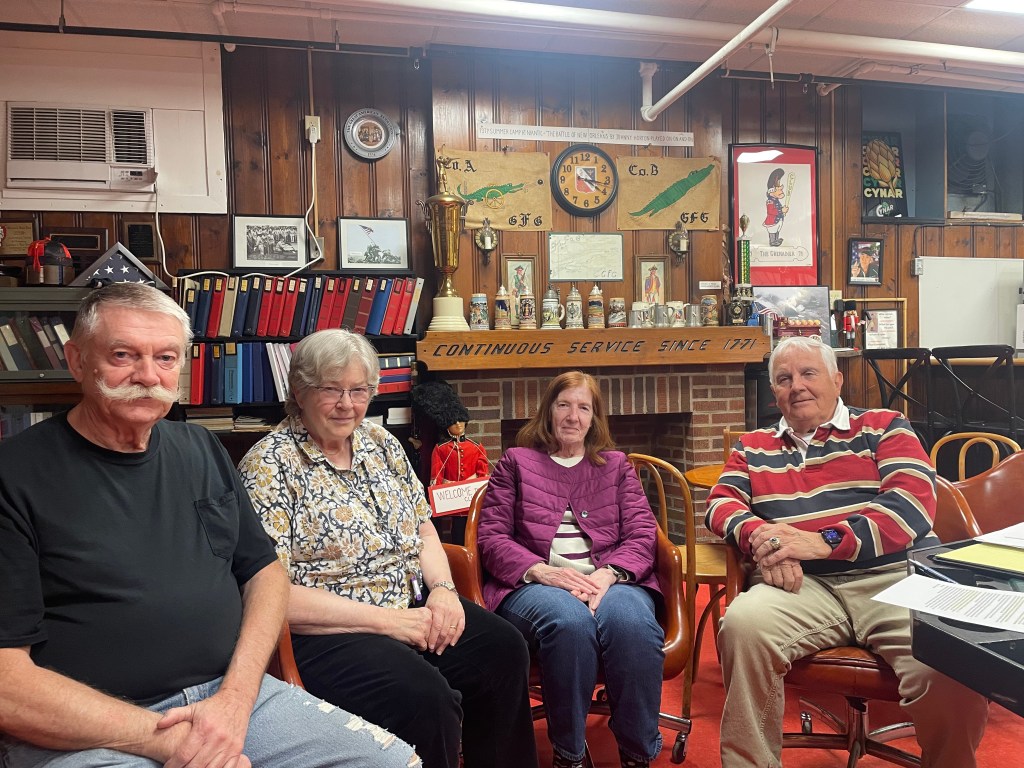
According to state statute, the First Company Foot Guard is managed by the Trustees whose headquarters is the armory on High Street in Hartford. Since 2009, the First Company Trustees receive no support or payment from the state. Instead, the Trustees rely on member dues and events to pay for upkeep, including the recent Hartford Theaterworks play about the Hartford Circus Fire. Their latest 501(c)3 filing shows the Trustees brought in $79,452 in 2024, constituting a small loss.

The High Street Armory museum houses thousands of pieces of war memorabilia donated by private individuals, along with pieces of Connecticut history, including the red uniforms and hundreds of old rifles used in parades that the attorney general says belong to the state and wants returned for use by the First Company 1-1’s now housed at the William A. O’Neill Armory across the street from the Legislative Office Building.
In the legal complaint lodged by state officials against the Board of Trustees, Assistant Attorney General Gary Hawes alleges the Trustees have “abandoned its charitable purpose and sought to usurp the office of the First Company Governor’s Foot Guard,” and have essentially blocked the First Company’s access to their High Street Armory headquarters, uniforms, and antique rifles. The state is asking the court to dissolve the organization, which was established as a nonprofit in 1985.
“In addition, the action seeks to stop the unauthorized and willful possession of State property that should be used for the benefit of the First Company,” the complaint continues. “Despite repeated requests for return of State property, one as recently as February 8, 2023, the Trustees continue to keep the Krag rifles, the Membership Book, uniforms, musical instruments and equipment, and other State items on lockdown, thereby depriving the Military Department and the First Company of their rightful possession of these items”
In a document written by Trustee Robert Szczepanski to other Trustees, he claims the lawsuit is filled with “false assertions,” states they have provided uniforms and equipment to the First Company, and says First Company members can use the High Street armory, provided they sign the membership book.
“The state cannot prove abandonment of purpose,” Szczepanski wrote. “The Attorney General and Military Department’s terms for dissolution of the bonds between the First Company Governor’s Foot Guard are unacceptable and amount to a complete surrendering of property and purpose while imposing an obligation to maintain the High Street armory for the eventual benefit of the state.”
“We think it’s bogus. Everything that we’ve done in our mission statement is for the Governor’s Foot Guard — maintaining the armory, maintaining the life and associate members, maintaining the band,” said Trustee Major Abe Grillo in an interview. “Just because one unit — the 1-1 members — left our armory because of orders that they weren’t supposed drill at our armory anymore doesn’t mean the Foot Guard Board of Trustees has neglected their responsibilities.”
If it all sounds somewhat confusing, that’s because it is: the lawsuit is the result of a long internecine fight between the Trustees, some 1-1 members, and the state’s Military Department. Essentially, both the State and the Trustees claim they are the true First Company Governor’s Foot Guard. There are even competing websites here and here, and state officials are demanding the Trustees take theirs down.
Another complicating factor of the conflict is that the Connecticut Military Department imposes an age restriction; those over 64 technically can’t be part of a military unit. If the Trustees’ Foot Guard is taken over by the state, pretty much everyone running the organization and many lifetime members will be forced to leave. The Second Company Governor’s Foot Guard, for instance, will not take members over 55 and members must pass a physical fitness test.
While the Foot Guard had long been housed on High Street, which the Trustees own, the state officially moved the headquarters of the First Company to the William A. O’Neill Armory in 2009 after the Connecticut Department of Public Works terminated a lease with the Trustees, but it was only for the 1-1 rifle company.
According to the lawsuit, the Trustees and the First Company “worked with each other so the members of the First Company could continue to use the High Street Armory for their benefit, though not in an official capacity.”
However, in 2017, facing depleted finances and need repairs to the armory, the Trustees levied a one-time assessment of $400 to keep the High Street Armory up and running. The state alleges that in 2019 the Trustees locked out the Commandant of the First Company and other members because they allegedly didn’t pay the fee. Therefore, they argue, the Trustees are no longer supporting the First Company by withholding access to the High Street Armory and the equipment held there, so it is seeking to dissolve the Trustees and acquire the property.
Grillo disputes the state’s allegations, saying that former Adjutant General Major General Thaddeus J. Martin attempted to rewrite the Foot Guard’s bylaws to exclude the lifetime and associate members, leaving only the 1-1 unit. When the Trustees pushed back, Grillo says, Martin ordered the 1-1 unit to the William A. O’Neill Armory. Grillo says they removed some of those members’ key fob access to High Street because those members were “stealing” equipment and gear from High Street.
The disagreement spilled over into the legislature with a bill proposed in 2018 that would have given the Adjutant General in charge of Connecticut’s Military Department the authority to rewrite militia bylaws, which would have essentially given him complete control over First Company.
The bill, however, was “arguably in conflict with the existing statute, which requires the First Company to make its bylaws with the approval of the Adjutant General,” wrote then House Speaker Joe Aresimowicz, D-Berlin, in testimony opposing the bill.
“The Military Department has gone out of its way and barred no expense to create statutory revisions and establish interpretations of their regulatory revisions in an attempt to control the by-laws and finances of the 1GFG,” wrote Trustee LTC John L. O’Connell in a letter to Sen. Mae Flexer, D-Windham, co-chair of the Committee on Veterans’ Affairs at the time. “We believe these actions to be unconstitutional and an illegal use of the government’s authority over private organizations.”
Eventually the legislation was altered, and the language allowing the Adjutant General to change the bylaws was stripped out. Aresimowicz endorsed a bill out of the House of Representatives that would “clarify the authority of the four companies to develop their own bylaws and permit the companies to retain control over the funds they raise through dues, appearances at parades and ceremonies and fundraising,” Aresimowicz wrote. That bill, however, went nowhere.
In April 2023, Judge Advocate General Lt. Robert V. Collins of the Centennial Legion of Historic Miliary Commands, an organization consisting of military units that were part of the original thirteen colonies, sent the Trustees a cease and desist letter warning of potential litigation if they did not cease to “falsely and/or misleadingly hold themselves out as the leaders of an organization purporting to be the ‘First Company Governor’s Foot Guard’ (1GFG) at a time when there is an actual, legitimate, and state-approved (via Connecticut General Statutes, practice, and tradition) First Company Governor’s Foot Guard.”
Collins went on to demand that the Trustees stop using any insignia of the Centennial Legion of Historic Military Commands, claim no affiliation with the entity, and were essentially kicked out and barred from being part of the Legion. Interestingly, the Trustees received a demand for $50 in 2026 as part of the unit member dues.
In 2025, a proposed bill backed by the Military Department sought to essentially privatize all the historic companies so the Military Department could devote more monetary resources to supporting troops, but the bill died after a remarkable amount of public comment, including opposition from all the historic companies.
This year, snuck into the 2026 budget is a provision establishing a Governor’s Foot Guard account which, “shall contain any moneys required by law to be deposited in the account, which shall include, but not be limited to, the proceeds of Governor’s Foot Guards programs.”
With the state asking the court to dissolve the Trustees and essentially turn over the property to the Military Department, that would likely include any monies raised by the Trustees through events and membership dues, and a free, historic building worth millions.
“As a result of the Trustees’ actions, and its exercise of dominion and control over the Property, the State was, and continues to be, wrongfully deprived of its use and possession of theProperty, resulting in a loss to the State,” Hawes wrote.
Nevertheless, Grillo hopes that there can be a reconciliation between the Foot Guard and the Military Department that would negate the need for a legal fight.
“We need to build a relationship, because the Military Department threw a wedge between our unit, they separated us,” Grillo said. “The 1-1 guys are welcome in our armory, but they were told by the attorneys on their side in the Military Department that they’re not allowed to come back here. But they’ve been wanting to come back here for over a year.”
The Military Department could only offer comment acknowledging the lawsuit against the Foot Guard.



Tong is a joke…..
Those units have absolutely nothing to do with any branch of the US Military. They are CT Ceremonial units. I wish people would stop saying they are in the military as opposed to what they really are, adult cub scouts.
Marc Fitch, for an investigative reporter, there is not one accurate statement in this article. What’s your angle with all these so called facts? Unfounded and unverified articles like this degrade the journalistic integrity of our profession.