


The State Elections Enforcement Commission (SEEC) voted on August 12 to investigate whether Windsor Locks Public Library violated state elections statutes that prohibit the use of state or municipal funds to encourage voters to approve or disapprove a referendum decision after the library sent out warnings to the public ahead of a town budget vote.
Windsor Locks held seven referendum votes on the town budget over the course of spring and summer 2026, with the budget finally being approved by a single vote in August. During that time, Windsor Locks Public Library was on the chopping block, with potential budget cuts upwards of 50 percent.
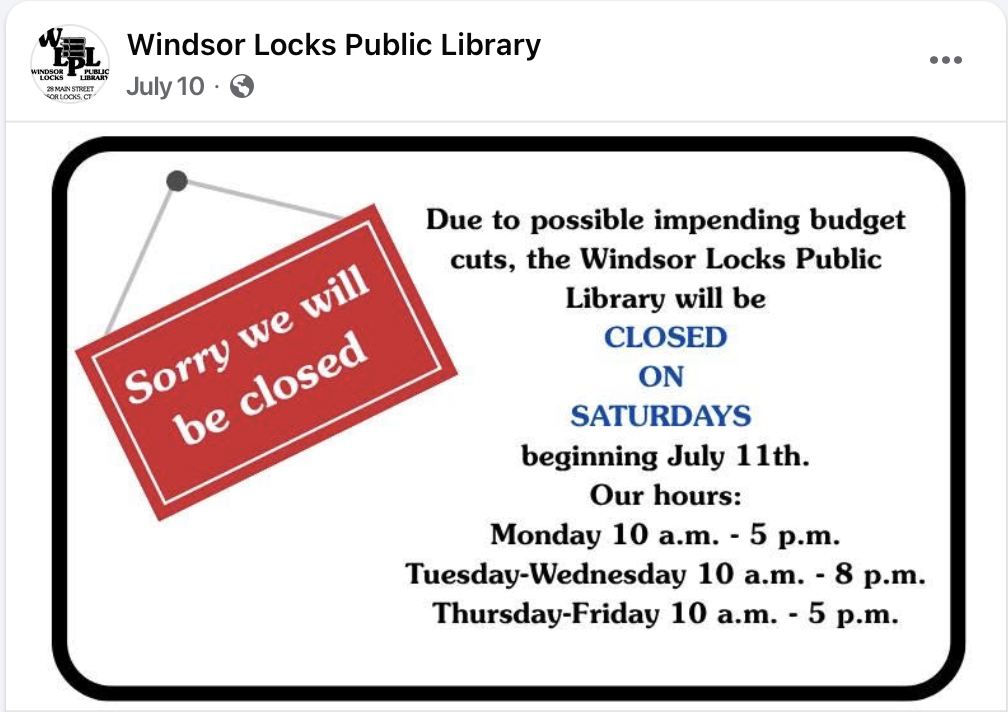
Ahead of the July 14th budget referendum, the library posted warnings on social media. A July 6 post called “Save Your Library” warned voters that the proposed cut would mean reduced staff, reduced hours of operation, no new books, no story times, and no new programs, and then encouraged voters to reject the budget. A follow-up post on July 10 announced the library would be closed on Saturdays, “Due to possible impending budget cuts,” even though the budget had not yet been voted on.
State and town officials in the past have been found to have violated this election law: in 2024, SEEC determined that East Windsor First Selectman violated the election law when he utilized the town’s automatic phone messaging system to encourage voters to approve a referendum question. Even the Connecticut Office of the Secretary of State was found to have violated the law when it used state resources to encourage voters to approve an early voting referendum.
However, there’s a twist in the case of the Windsor Locks Public Library: it is technically a nonprofit, and while it receives most of its money from the town through the budget, it is not technically a municipal entity, according to a prior decision by the Connecticut Freedom of Information Commission (FOIC).
Windsor Locks Public Library is a registered 501(c)3 organization and, according to their 2025 990 tax filing, had total revenue of $524,964, with $510,660 of that coming from government grants. According to Windsor Locks budget documents, that year the town sent $508,175 to the library.
While the library has its own line in the town budget, it is not controlled by the town but is rather governed by a board of directors made up of volunteers and, according to the 2023 FOIC decision, doesn’t meet the state definition of a public agency or the equivalent of a public agency.
The complainant in the FOIC case had argued that because the town provides so much of the library’s budget, purportedly had a $1 lease agreement for the property, and benefited from various town services like snow removal, it constituted a public agency and therefore had to comply with FOI laws when it came to noticing board meetings.
While the FOIC found the library did meet the definition of a public agency when it came to funding, it also found that the library was not controlled or regulated by the town, was not created by the town, and is not required by statute to provide services. Although the complainant dropped his case, the FOIC still issued a decision dismissing the complaint.
The July 14 budget referendum was the fourth vote on the town’s budget, which had become contentious, in part, because of the library issue. That budget, which would have reduced the library funding by $235,000, was again voted down.
By the fifth budget vote, the Board of Selectmen said they had cut $600,000, including $100,000 in employee benefits, job reductions, and education cuts. According to a memorandum from First Selectman Jon Savino following the third budget referendum, the cuts “moved beyond individual budget line items,” and were now “directly changing municipal operations,” like reducing the number of days town hall is open.
By the seventh vote, approving a $64.1 million budget, the library’s funding was kept basically flat from the previous year at $470,179, which still constituted a nearly $38,000 reduction from 2025.
In a somewhat similar case earlier this year, SEEC investigated a complaint against the Willington public schools superintendent, who sent out a digital flyer “advocating in favor of a referendum regarding the school budget.”
SEEC determined there was no violation because the flyer was sent on May 15, 2026, but “the referendum in question was not legally pending until May 20, 2026, after the board of selectmen voted to schedule the date and location of the referendum.”



Using taxpayer funds and official resources to campaign on a local referendum crosses an ethical line, regardless of which department or non-profit is involved.
Under Connecticut law (C.G.S. § 9-369b), public entities are strictly prohibited from using public funds, staff hours, or official channels to influence how residents vote on a referendum.
While the library operates under a 501(c)(3) non-profit board, tax records show it relies almost entirely on local taxpayers, receiving $508,175 in municipal tax grants out of its $524,964 total revenue in 2025. Using public tax-funded platforms to lobby for more public tax money raises several major concerns:
Compelled Taxpayer Advocacy: Tax dollars paid for the official platforms and paid staff time used to post campaign warnings and direct voters to reject the budget. Taxpayers should not be forced to subsidize political advocacy, especially when it may run counter to their own voting preferences.
Preemptive Service Reductions: Shutting down Saturday hours before a budget referendum was even finalized comes across as political pressure tactics rather than sound administrative management.
Double Standard on Transparency: An entity cannot claim private non-profit status to dodge public election neutrality rules while simultaneously drawing nearly 97% of its funding from the municipal budget.
Erosion of Public Trust: Libraries are meant to be neutral civic sanctuaries for the entire community. Turning official channels into advocacy tools damages credibility and divides the town.
Public funds belong to all taxpayers, and municipal resources must remain strictly neutral during referendums. The SEEC investigation is an essential step in ensuring financial accountability and transparency in Windsor Locks.