

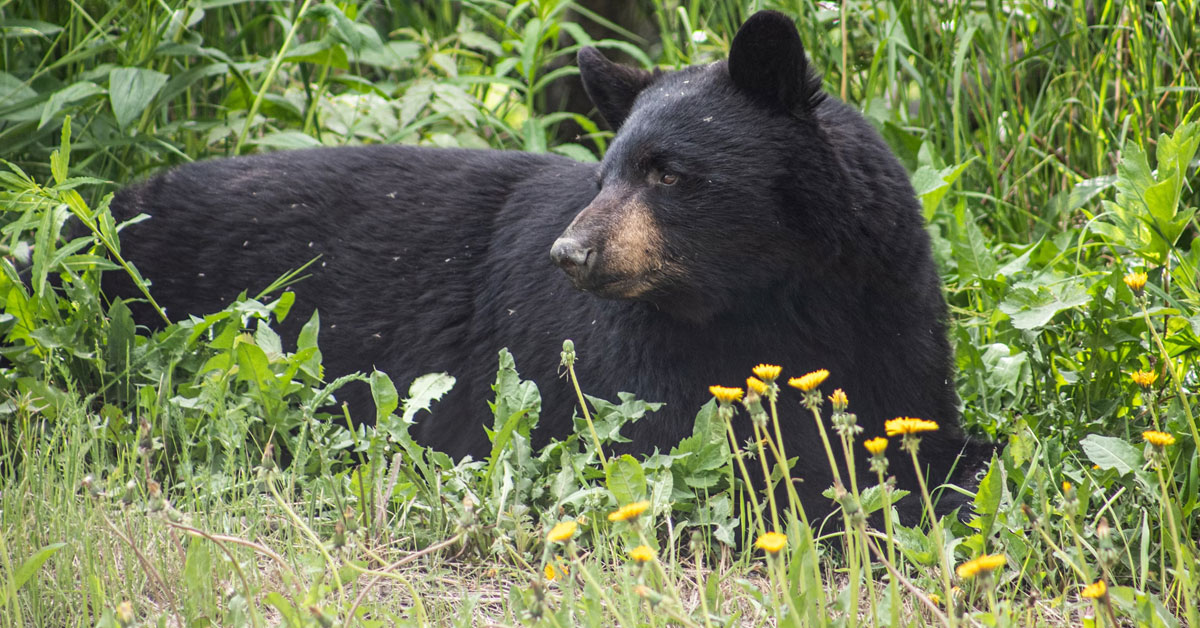
Activists are mobilizing around one of the most contentious environmental debates in the state: bear hunting.
Next month, the Connecticut Department of Energy and Environmental Protection (DEEP) will hold four Bear Management Listening Sessions around the state. The Connecticut Wildlife Rehabilitation Association (CWRA) is calling for people to show up to these meetings and condemn any proposals to legalize bear hunting in the state.
“It’s vital to attend one because the hunters are already mobilizing their members – and their lopsided attendance will lead DEEP to wrongly conclude that the public wants a bear hunt in CT!” a post from CRWA’s Facebook page states.
Connecticut and Rhode Island are the only two states in the Northeast with complete bans on bear hunting. Connecticut also has more bear encounters than any of its neighboring states.
Connecticut has the highest number of overall human-bear conflicts, as well as the highest number of home entries per 100 bears, out of any state in the Northeast, according to DEEP’s 2025 The State of the Bears Report. In 2023, there were 3,093 human-bear conflicts in the state. That same year, Massachusetts, which has twice the bear population as Connecticut, had only 645 human-bear conflicts.
In 2024, there were two incidents where bears attacked humans, according to the 2025 The State of the Bears report. As of Oct. 9, DEEP has documented more than 30 home break-ins in 16 towns in Connecticut.
There are a handful of exceptions to the prohibition on killing bears: since 2023, farmers who have exhausted non-lethal methods to repel bears can apply for permits to kill bears if they are damaging crops, livestock, or apiaries. People can also kill bears in self-defense or in defense of domestic animals.
“Unfortunately, hunters and DEEP are using bear conflicts to push for legislation to open up CT for sport hunting, knowing many people have knee-jerk “kill” responses rather than understanding the need to solve the problem at its source,” CWRA’s Facebook post stated.
For years, a bipartisan group of politicians—with the support of DEEP—have tried to legalize bear hunting. However, every year, there is a pushback from environmental groups and some Democrats who claim that bear hunting is an inefficient way of stopping human-bear interactions, claim that hunting is ineffective at best, cruel at worst, and have often criticized the contents of proposed legislation.
This legislative session, language in the proposed legislation, SB 1523, “An Act Concerning Bear Hunting,” failed to pass through the Senate.
“The way to stop human-bear conflicts is to eliminate what’s attracting the bears — ie FOOD. This was the resounding message at the international bear conference held recently in Montana,” CWRA’s post states.
This conference, the International Bear-Human Conflict Workshop, took place in October. It was hosted by the International Association for Bear Research and Management.
“Why hunting doesn’t work was also discussed — the wrong bears are taken out, orphaned cubs are left behind, the attractants remain to entice more bears, the result is continual conflicts,” the post states. “The answer lies in changing OUR behavior, and that’s the biggest challenge.”
Despite claims of many activists, the science is not settled.
Most bears in the state travel throughout the year between rural, suburban, and urban environments, according to The State of the Bears report.
The majority of human-bear conflicts in the state have happened because of trash and bird feeders, according to the State of the Bear report. DEEP ran a public awareness campaign last year, which generated 10.2 million impressions online. This campaign focused on food as a driver of human-bear interactions. Despite this, the number of bear-human conflicts has increased in recent years.
The listening sessions will occur on:
Tuesday, Dec. 2 at the Sessions Woods Wildlife Management Area, 341 Milford St, Burlington, CT 06013
Wednesday, Dec. 3 at the Audubon, 325 Cornwall Bridge Rd, Sharon, CT 06069
Thursday, Dec. 4 at the Kellogg Environmental Center, 500 Hawthorne Ave, Derby, CT 06418
Tuesday, Dec. 16 at the Elmwood Community Center, 1106 New Britain Ave, West Hartford, CT 06110
Each session will take place from 6-7:30 p.m. The sessions are free, but people need to RSVP in advance.




Very frustrating issue in my neck of the woods in Ct. I agree Food is the major issue but when neighbors of at least average intelligence purposefully leave food out for the bears, call them to their porches loaded with “beat treats” I am left with feeling the problem at least near me will not change. Neighbors who do this tell me I’m a bear hater and have even accused me of shooting and killing bears in the area. Absolutely untrue. I am an animal lover and the accusations hurt me deeply.
Of course ever since early humans devised weapons we have been a positive check on bears. A hunt might be tolerated but, the burbs with the most problems are so dense that one probably couldn’t discharge a firearm legally in the neighborhood. Currently a PA resident in the greater NY statistical area, I can walk from my house in town to state game lands in 20 minutes. There must still be some inland parts of CT where safe hunting is still possible and would have more resident hunters per capita as well. For the rest bear proof containers and ordinances to require best practices. Not easy.
Former Milford, CT resident, currently resident Milford, PA