

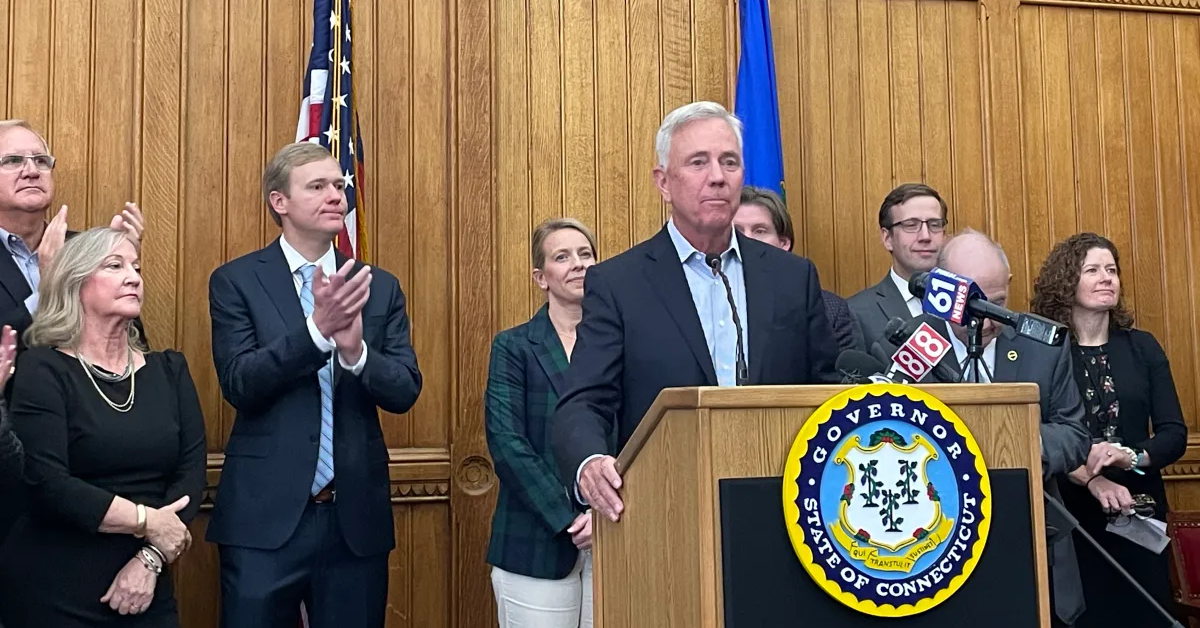
Gov. Ned Lamont and legislative leaders say they will return to the drawing board to discuss how Connecticut could continue plans to phase out the sale of gasoline-powered cars, after Lamont hit the brakes on a regulation that would have required all new vehicles sold in the state to be electric or zero-emission by 2035.
The sweeping and controversial regulatory change championed by the Department of Energy and Environmental Protection (DEEP) would have begun limiting the number of new gasoline powered cars in 2027 and ramped up over the course of eight years until the only gas-powered cars available for purchase in the state would be used cars.
Connecticut is tied to California’s emission standards instead of the federal emission standards and following California’s announcement in 2022 that it would begin phasing out the sale of new gasoline cars, Connecticut was statutorily obligated to follow suit.
However, the change first had to clear the bipartisan Regulation Review Committee. A committee vote against the regulation could have potentially killed it permanently and Lamont withdrew the regulation change upon learning it likely wouldn’t pass.
Lamont, however, said during a press conference today that it is necessary for the government to set clear future goals and rules so that businesses and industry may invest accordingly.
“General Motors is already committing all electric, 2035. Is Connecticut going to be the first to renege on a commitment we made on a strongly bipartisan basis two years ago, on a unanimous basis twenty years ago?” Lamont said. “It has worked. It worked back in the seventies when it came to fuel efficiency standards. Look where we are today, we have tripled the number of EV sales just in the last few years, we have brought down the price by over one-third.”
Lamont and Democrat leaders in the House and Senate indicated that the issue will be taken up in the General Assembly during the 2024 session or possibly sooner – something Republicans in the House and Senate had been pushing for, despite being vastly outnumbered by Democrats.
House Speaker Matthew Ritter, D-Hartford, said affordability concerns, both for the cost of electric vehicles and getting the infrastructure in place to support the change are real concerns that must be addressed by the General Assembly.
“We have things we need to do in turn that will be part of a larger bill,” Ritter said. “We have to do more. We have to demonstrate to the Connecticut residents that this switch will not only save the environment – save lives and save our planet – but not leave you in a position where you can no longer afford a vehicle.”
Senate President Pro-Tempore Martin Looney, D-New Haven, said that the divide between rich and poor may become more pronounced with the adoption of electric vehicles and building charging stations, as wealthier residents could afford home chargers, while others will have to find public places to charge their vehicles, as opposed to gas stations, where everyone fills their tanks. “That won’t be the future, necessarily, we will have a divide.”
“We know that gasoline cars are on their way out and we will have all electric vehicles in the future, and we want to make sure that future happens as soon as we can,” Looney said. “We also have to make sure that future happens in an equitable way, not leaving any communities behind.”
Speakers floated the idea of establishing five-year updates on the plan to ensure that everything is moving forward and addressing concerns as they arise regarding costs, infrastructure and the state’s commitments to the environment.
DEEP and environmental groups in support of the change argued that it was necessary to create cleaner air, meet Connecticut’s self-imposed emissions goals and help combat climate change. DEEP argued that cleaner air from fewer emissions would create a net positive result for the state through decreased sick time and healthcare costs.
However, Republicans and representatives of gas stations and truckers argued that neither the technology nor the state’s infrastructure is ready for such a massive change over the course of only eight years. Concerns about the state’s electric grid, the region’s energy capacity, EV charging infrastructure and higher costs has plagued the plan, with little offered from proponents on how any of those issues would be handled.
House and Senate Republicans held their own press conference following Lamont’s to reiterate their stance on the EV regulation.
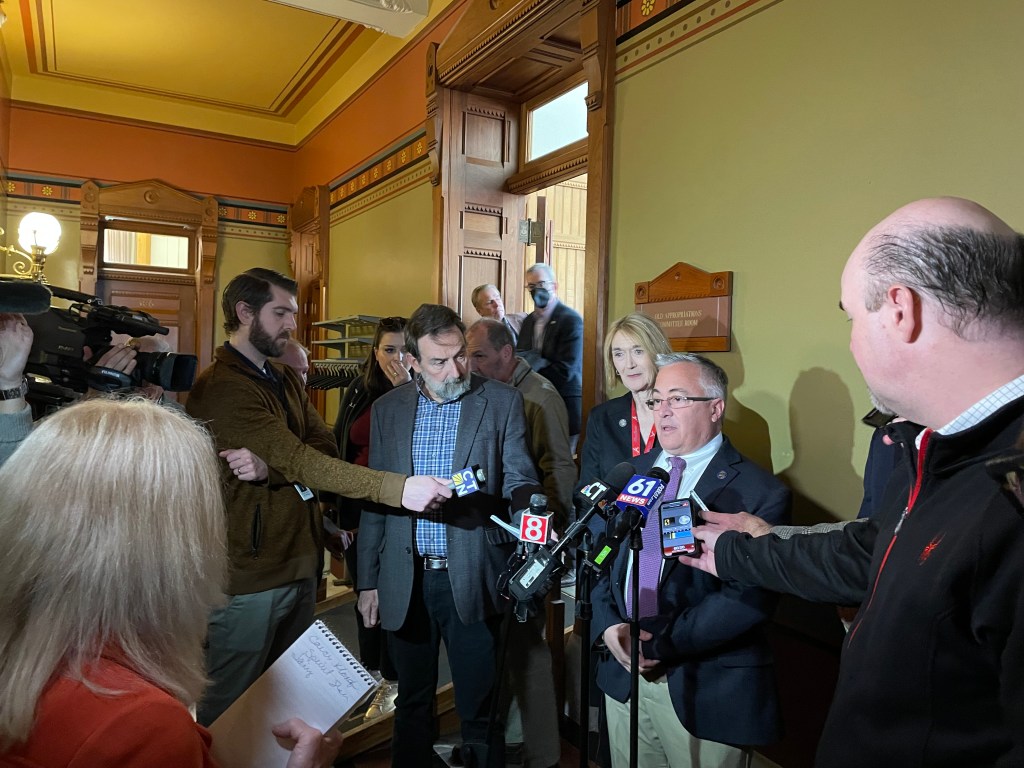
Republican House Leader Vincent Candelora, R-North Branford, said that Democrats mostly admitted that they had no real plan to implement these regulations, particularly when it came to Connecticut’s electric infrastructure. Republicans had launched a campaign saying the change was a “Ban With No Plan.”
“I think what the press conference today just demonstrated is the governor’s office does not actually have a plan,” Candelora said. “I think moving forward, it’s good to hear they will start taking into consideration the affordability, the impact this is actually going to have on Connecticut residents and we’re looking forward to having that conversation.”
Ritter said this issue is a priority for the legislature and will be caucusing with his members on Monday to figure out where everyone stands and what concerns need to be addressed but stopped short of saying whether there will be a special session in January to hold a vote.
Candelora and Republican Senate Leader Kevin Kelly, R-Stratford, said this is an issue that deserves a full public hearing and discussions with Eversource to determine how the electric grid will need to be built out to support the increased demand.
“They didn’t put forward a plan. We need more than a regulation; they’ve admitted there’s no plan to back up what those regulations had,” Kelly said. “Quite frankly, I would hope that we would have the benefit of a public hearing. We want to hear, we need to hear in this building, the people’s voice.”
The 2024 legislative session will certainly be the deciding moment, according to DEEP Commissioner Katie Dykes, who said that car manufacturers and the industry needs a three-year lead time to conform with the regulations should Connecticut pass them, otherwise, the default would be to federal standards.
“The California program requires three years’ time to give manufacturers advanced notice of when the state will be implementing those standards,” Dykes said. “To implement the standards for model year 2027, the regulations would have to be adopted by the end of this calendar year. Moving into 2024 would give us the opportunity to implement the standards for the 2028 model year.”



Anyone who knows Anything about the American electric grid, knows that we CANNOT SUPPLY the demands for what we Currently have. Adding to that, will literally COLLAPSE OUR ELECTRIC GRID! And yet, these dummies who support this insanity, refuse to deal in Reality! Once the Grid is down, you will be WITHOUT ELECTRICITY 🔌! No food in the stores, no heat or cooking. No driving EVs. And, once the Grid goes down, 9 out of 10 people will Die, within the first Year… Let me repeat that… WHEN WE LOSE OUR ELECTRIC GRID, (9) NINE OUT OF (10) TEN PEOPLE WILL DIE, WITHIN THE FIRST YEAR OF BEING WITHOUT ELECTRICITY… And that’s exactly what they want… Wake TF up and Stop following the insanity!
Agreed!!! Vote RED!!!
Democrats will punish us by imposing ever higher taxes on motor fuels to encourage us to make the switch to electric vehicles. At some point a buzz word with the -phobia suffix will be used to describe anyone who voices negative comments about the push to eliminate hydrocarbon fuels in favor of electric cars. The lapdog media and night time political pundits will undoubtedly lambaste the -phobes to push the agenda. Sound familiar?
MamaKarma 13 has the problem exactly right. I’d add to that the a government of the people, by the people, and for the people is NOT supposed to be a government of the politicians, by the bureaucrats, and for the globalists! Neither the CT government nor the federal government have legitimate authority to ban our choices of consumer products. That goes for leaf blowers, gas stoves, air conditioners and everything else that would tear down our standard of living. Meanwhile crime is rampant and criminals are let out of prison before their terms are up, our state budget is bloated, and the elites in Hartford are determined to destroy our small towns with mandates to overbuild multifamily units. Tyranny or Freedom? You choose.
The sooner we dump the Democrats at every level we can get this country back to some common sense and sanity. As evidenced in Louisiana and as close as Long Island the movement to dump the insane Democrats is picking up steam! Let’s free Connecticut from these wacko’s.
So true Norm
The IPCC projects a temperature increase of 1.5 degrees C (2.7 degrees F) by 2100. If this even remotely happened, this amounts to less than the difference between the average annual temperature of Hartford and that of central New Jersey.
How many people have considered the impact of such a temperature rise for people in certain locales? Certainly not Lamont and the CT Democrats because this is al about government control by a fascist cabal using fear as its weapon. And let’s be clear: government control over industry IS fascism, not just an invective wildly thrown at your political opponents.
Consider the fact that, according to NOAA, the average mean temperature in Connecticut is 48 degrees F. If it rose 2.7 degrees Fahrenheit, it would still be less (48 + 2.7 = 50.7 F) than the average mean temperature of New Jersey (51.4 degrees F). By contrast, the average mean temperature in Maryland is 53.8 degrees F, in GA 63.4 degrees F, and in FL 70.1 degrees F. Are people in those states dropping like flies from the heat? No! Americans by the millions are migrating, adapting, or retiring, to southern states for the warmer climates, like FL where the average annual temperature is 70.1 degrees F. To call the modest temperature increases we have experienced since the end of the Little Ice Age in 1850 an “existential crisis” is nonsense, most of it cyclical. And not just nonsense, but dangerous nonsense because the forces pushing these extreme measures are contributing to a worldwide program of banning fossil fuels that will cause the death of upwards of three BILLION of the eight BILLION people on the planet if fully implemented.
Read Alex Epstein’s “Fossil Future,” and Steven Koonin’s “Unsettled” for many honest and well documented insights.