

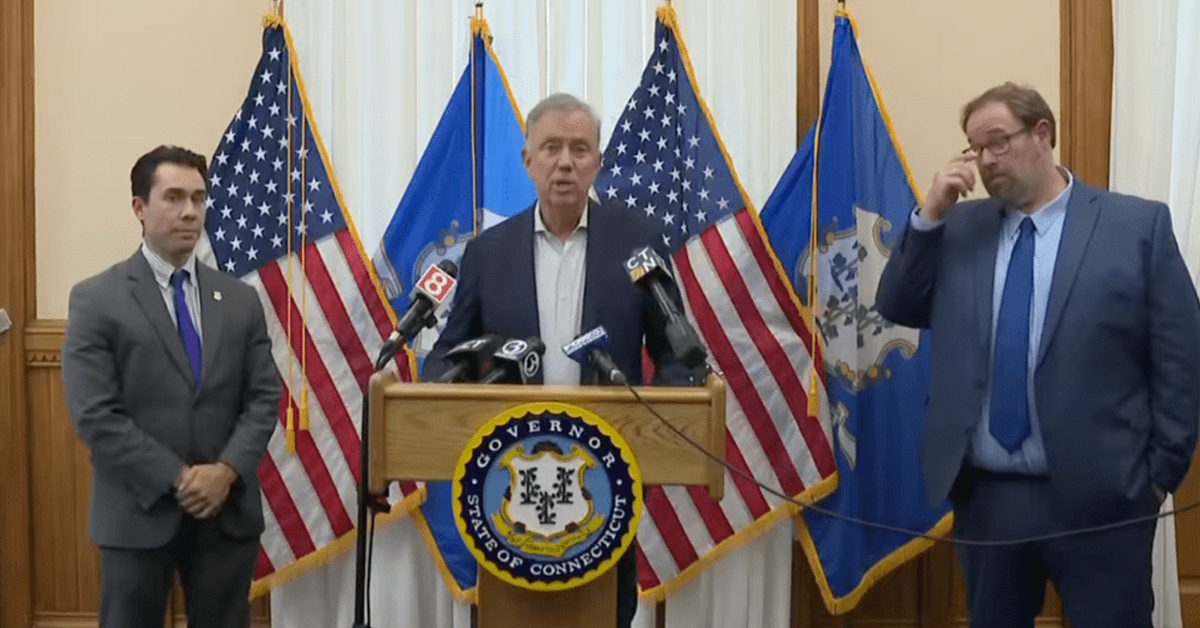
Gov. Ned Lamont and his Chief of Staff Matthew Brokman were both warned that former Public Utilities Regulatory Authority (PURA) Chairman Marissa Gillett was freezing out the other commissioners by withholding access to staff members as early as 2023, according to sworn testimony given by PURA Commissioner Michael Caron during deposition.
Caron testified that he personally spoke with Brokman, who was Lamont’s senior advisor at the time, in 2023 and again at a “subsequent time” during which he told both Brokman and Lamont, “how Vice Chair Betkoski and I were being treated and not being full partners in the Authority leadership.”
“I recall the governor saying, when I mentioned that I don’t have access to staff, he replied, to the effect, Well, you’re a commissioner. You can go to staff any time you want,” Caron said. When asked during deposition if that was actually the case at PURA, Caron said, “No,” and indicated that it was a dramatic departure from past practice.
“It’s not that I didn’t ultimately have access. It was controlled access that I had or could have. But I was expected to follow the dockets as the evidence was posted with the interrogatories, the answers to interrogatories, briefs, reply briefs, post decision. I had access to all that. Essentially, I was my own staff,” Caron testified. “I found it overwhelming to keep up by myself.”
According to testimony supplied by Caron and documents obtained by the utility companies through Freedom of Information requests as part of their various lawsuits and appeals in superior court, Gillett’s Chief of Staff, Theresa Govert, sent an email asking commissioners to request access to staff through her, a practice that did not previously occur at PURA before Gillett’s tenure.
Caron further testified that he found the directive insulting and he believed “the chair wanted to be sure somebody was in the room with me when I was talking with staff about anything.”
Despite the warnings from Caron, the utility companies, and House Republican Leader Vincent Candelora, R-North Branford, Lamont renominated Gillett to PURA in 2025, whereupon she denied that she was limiting commissioners’ access to staff before the Executive and Legislative Nominations Committee.
Lamont went on to reappoint Gillett as PURA’s chair in June of 2025, despite her questionable testimony before the nominations committee, which was later refuted by internal emails contradicting Gillett’s testimony and confirming what Lamont had allegedly already been told two years earlier by Commissioner Caron.
“The Governor’s decision to renominate Chair Gillett was based on her breadth of knowledge, analytical skillset, and experience in energy policy, combined with her commitment to fairness and her ability to navigate complex cases,” the Governor’s Office wrote in a statement. “Differences in management style or approach among commissioners of multi-member regulatory bodies are not unique nor are they an indication of wrongdoing.”
Following the release of those documents, Candelora sent a letter to House Leader Matthew Ritter, D-Hartford, requesting a Committee of Inquiry as to whether Gillett should be impeached. Gillett resigned shortly thereafter. PURA has attempted to use Gillett’s resignation to end a lawsuit and rate case appeal currently before the courts, but has thus far been unsuccessful.
“I had expressed my concerns all along that not only was the governor ignoring the personality problems at PURA and the accusations of chairman overreach, but he was also ignoring the law in not fulfilling the appointment of all five members,” Candelora said. “I’m not sure how granular the governor was in watching those [Executive and Legislative Nomination Committee] hearings, but based on the information I was told in my meetings with Caron and Betkoski, it seemed to suggest that she was withholding staff.”
Caron’s testimony, however, addressed several other issues before the court. Specifically, Caron testified he believes Gillett had a hand in drafting an op-ed authored by the chairs of the legislature’s Energy and Technology Committee, Rep. Jonathan Steinberg, D-Westport, and Sen. Norm Needleman, D-Essex. As a commissioner, Gillett was supposed to be impartial and her participation in such an op-ed would demonstrate a bias that could affect decisions issued by PURA.
Caron said he didn’t believe the lawmakers had the “inside knowledge that the op-ed provided about the operations of an investment company’s work,” and added the argument presented in the op-ed – that the utility companies were working in tandem with credit rating agencies to undermine Gillett – was “preposterous.”
While Steinberg and Needleman maintain they “authored” the op-ed, both legislators are trying to evade deposition and dodge discovery that would grant utility attorneys access to their cell phones and documents. Text messages between Steinberg and Gillett, uncovered by the Hartford Courant, discuss a “draft” shortly before the op-ed was released. Gillett then emailed the op-ed to the rest of the PURA staff.
It was later revealed in court that both Gillett and Chief of Staff Govert had set their phones to auto-delete text messages after thirty days. According to Caron’s testimony, Gillett had told both him and former PURA Vice Chair John Betkoski that her phone auto-deleted years earlier.
Caron’s testimony painted a picture of a powerful authority that changed abruptly under Gillett’s tenure: whereas previously commissioners took turns acting as presiding officer over rate cases, Gillett took over as presiding officer for nearly every docket, something PURA has now admitted violated state statute. Commissioners’ offices began to be locked, sequestering them away from staff, and Caron says he was no longer included in hiring interviews for staff managers. He claims PURA became a culture in which, when staff disagreed with Gillett, they were given “special projects” that ultimately pushed them out of the Authority.
Gillett issued thousands of motion decisions when acting as self-appointed presiding officer over PURA dockets. Those decisions included substantial findings, such as one in which Gillett ruled that she wasn’t biased against the utility companies. Caron also claims Gillett made unilateral findings against an energy company owned by Sen. John Fonfara, D-Hartford, whose company received fines totaling $1 million. Caron says he doesn’t remember the fine being assessed.
A count of 6,133 motion decisions was provided by the Governor’s Office to the Hartford Courant in February of 2025, purportedly in defense of Gillett and PURA. However, Caron says he maybe had input on ten of them, according to the deposition.
Despite PURA’s pivot in court to get cases against them dismissed now that Gillett is gone, further revelations of how the Authority has conducted itself has been nothing but negative; PURA admitted that it violated state statute by Gillett appointing herself presiding officer, and PURA and its General Counsel Scott Muska were chastised by Superior Court Judge Matthew Budzik for misleading the court.
Muska recently sent cease and desist letters to PURA commissioners, including Caron, and PURA’s Executive Secretary Jeffrey Gaudiosi, claiming they were defaming him and threatening a lawsuit after an email was published in which Gaudiosi claimed Muska was preventing documents from being released.
During the legislative session, proposed legislation was altered in ways that would have given Gillett legal cover for appointing herself presiding officer. Caron, a former Republican state representative, testified that Gillett never discussed legislation with him and went outside the usual Executive Branch process, which would normally see requests regarding PURA go through the Department of Energy and Environmental Protection and the Office of Policy and Management. Instead, he believes Gillett went through Needleman and Steinberg for her legislative requests.
After the language granting Gillett statutory authority to control all dockets was stripped from the bill, Lamont agreed to appoint the full statutorily-required five commissioners to the Authority – something he had resisted during Gillett’s tenure, even after being warned that she was blocking other commissioners from full participation. Having only three commissioners essentially guaranteed Gillett’s continued control over dockets as presiding officer because she was the chairman.
Lamont announced his nomination of four new commissioners to PURA, including former Consumer Counsel Attorney Thomas Wiehl and former Republican lawmaker Holly Cheeseman. Lamont did not nominate Caron for another term, claiming it was “time to make a change.”
“The Governor’s Office continues to support transparency and collegial governance at PURA and expects all commissioners to participate fully and respectfully in carrying out the Authority’s responsibilities to ratepayers,” the Governor’s Office wrote.
Meanwhile, the state has also hired an outside law firm to investigate alleged misconduct at PURA, following claims that documents were improperly withheld.
“After six years, he finally filled all the positions, and I’m grateful for that, but it should have taken six years,” Candelora said. “I would suggest that it probably led to an exacerbated problem at PURA because we didn’t have a full complement of commissioners.”
“There was so much neglect of that Commission, and we are going to continue to see the warts coming out in court, and I think those proceedings continue on regardless of her resignation because it was so pervasive and became a culture within that agency,” Candelora said. “I’m hoping that it can be corrected quickly because, when the day is done, as we all saw, it impacts the ratepayers.”



Isn’t all of this illegal and goes against established laws. The governor can be held accountable because he works for the public. No one is above the law and hopefully we can have a federal investigation because some Connecticut state workers are untrustworthy and steal from the public daily.
Less we forget all the audits of governor Lamont and his office staff, deliberately ignoring laws and work rules, using state property, for personal use.
Like a never ending rental car, that the tax payers, pay for.
Of course he knew,he is the head of the Skunk works of Corrupticut