


Congressional Republican primary candidate in the fifth district, Jonathan De Barros, has filed a lawsuit seeking an injunction against several supporters of his Republican rival Chris Shea after De Barros said they swayed delegates away from supporting him during the Republican Party convention in May and defamed him in public venues by claiming he is a “murderer.”
De Barros, a firebrand whose online social media posts against GOP officials and politicians prompted a review by Capitol Police, claims in his lawsuit that Republican House of Representatives nominee Jeffrey Weiss, former GOP candidate Pam Salomone, and podcast hosts Dawn Moriorano and Steve Pedbereznak defamed him on social media, cost him eight votes at the Republican convention, and inflicted emotional distress by referring to him as a “murderer.”
De Barros, who lost the Republican nomination but qualified to be on the primary ballot, is asking the court to enjoin the defendants to stop them from repeating those claims that he says will damage his chances in the August primary. Shea, who won the Republican Party endorsement, is a North Haven firefighter and retired Navy SEAL.
“Unless the Defendants are preliminarily and permanently enjoined from the foregoing conduct, plaintiff will be irreparably harmed by: Defendants continued reference to him as a ‘murderer’ in an ongoing effort to prevent him from winning the Congressional seat and defame him to the community at large,” attorney Michelle N. Holmes wrote in the complaint.
De Barros was convicted of murder in a 1996 shooting, but that conviction was overturned. De Barros did shoot and kill Jermaine Lewis on October 13, 1996, but claims the shooting was an act of self-defense, and the Appellate Court determined the trial court had erred in not instructing the jury properly on the charges and potential lesser charges, and that the trial court improperly suppressed evidence that would “likely affect the result of the trial.”
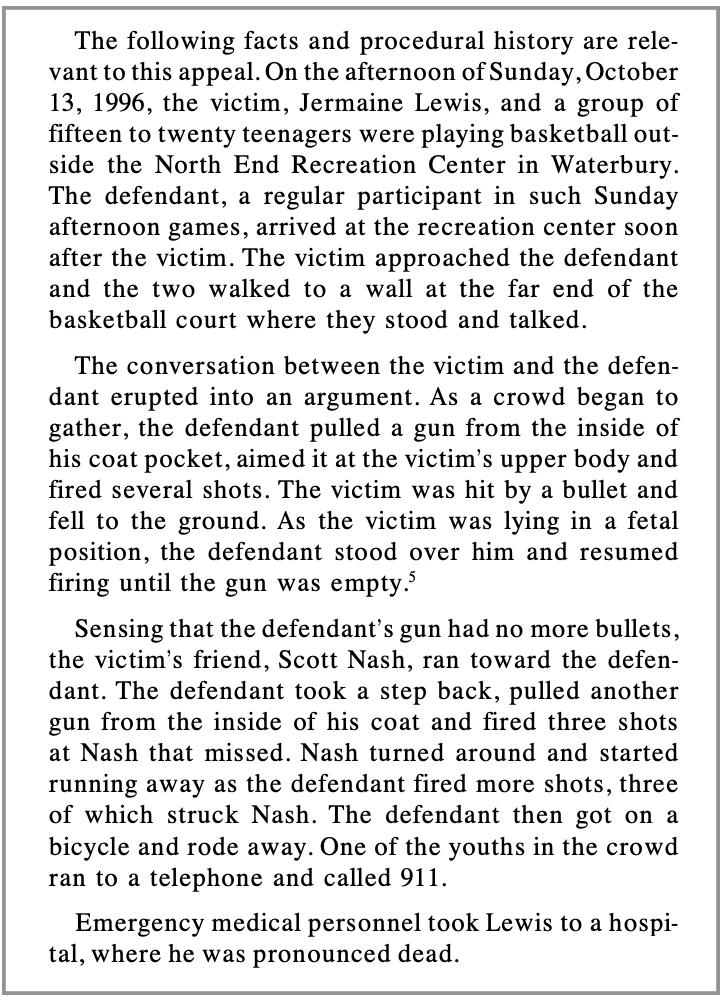
His second trial resulted in a hung jury, and facing a third trial, De Barros says attorney costs eventually pushed him to take a plea deal for manslaughter under the Alfred Doctrine – meaning he never admitted guilt but admitted there was enough evidence to convict him, according to public testimony he submitted to the General Assembly’s Committee on the Judiciary in 2008.
After serving his time, De Barros received a full pardon in 2021 by the Connecticut Board of Pardons and Parole; “you are now legally able to truthfully state you have never been arrested or convicted in the state of Connecticut as it relates to any of the convictions pardoned,” the March 2022 letter from his parole officer stated.
De Barros claims Salamone, Weiss, Mariorano, and Pedbereznak – a former Waterbury police officer – repeatedly asserted he is a murderer in public communications and at the convention, thus making “false statements with malicious intent to cause the Plaintiff harm and to interfere with his campaign,” according to the complaint.
“After the first round (of convention voting) Defendant Pam Salamone began circling the room speaking to people stating that the Plaintiff is ‘a murderer’ do you really want a ‘murderer’ representing you,” attorney Holmes wrote. “Defendants Pedbereznak and Mariorano appeared live on Facebook stream and called the Plaintiff a ‘murderer.’ This is a false statement of fact. Specifically, Pedbereznak brought up his prior employment as a police officer with the City of Waterbury and his alleged knowledge of ‘facts.’”
Similarly, De Barros alleges Jeffrey Weiss made “repeated statements on social media,” referring to him as a murderer.
Weiss is the Republican nominee set to face long-time state representative Liz Linehan, D-Cheshire, who defeated Pam Salamone by a very slim margin in the 2020 elections. Linehan went on to win handily against Randy Raines in 2022 and ran unopposed in 2024.
Mariorano unsuccessfully ran for Waterbury mayor in 2023 and now hosts the Brass City on Reels podcast with Pedbereznack who, in February 2026, was wrapped up in controversy after revealing on the podcast that a police officer had shared confidential information with him.
Weiss, represented by attorney and state representative Craig Fishbein, R-Wallingford, has filed a motion for dismissal on the grounds of free speech and Connecticut’s 2017 Anti-SLAPP law, which allows for special dismissal of lawsuits intended to suppress political speech or speech or matters of public concern.
“Since Plaintiff DeBarros is a candidate in the upcoming Republican primary election, any alleged statements by Defendant Weiss involving DeBarros’ criminal acts and convictions bear on public safety and community welfare,” the special motion to dismiss states. “These are issues that naturally would be relevant to voters evaluating a candidate such as DeBarros for public office. Therefore, it is blatantly obvious that this subject constitutes matters of public concern.”
Fishbein also argues that Weiss’ statements are a “substantial truth,” in that “minor inaccuracies will not defeat the defense so long as the gist or substance of the statement is true.”
“In this case, the alleged statement(s) at issue concern Plaintiff DeBarros’ involvement in a homicide for which he was originally convicted of murder, as well as other things, and ultimately entered a plea to manslaughter—giving-up his right to prove his acts were self- defense, and thus exoneration,” Fishbein wrote. “Any difference between the legal labels ‘murder’ and ‘manslaughter’ do not materially alter the effect on the ordinary reader and, therefore, do not create any actionable falsity.”
The winner of the August 11 Republican primary vote will go on to face Congresswomen Jahana Hayes in November. Hayes has represented the fifth district since 2018, which has typically been the closest Connecticut has to a Congressional swing district, narrowly beating George Logan in 2022 and then again by a wider margin in 2024.
De Barros also claims the defendants’ statements “created an unreasonable risk that the Plaintiff would suffer emotional distress;” he is not only asking the court to enjoin the defendants from making any further defamatory statements but is seeking compensatory and punitive damages.
“As a direct and proximate result of the Defendants’ actions, the Plaintiff has suffered immediate harm and will continue to be damaged if the Defendants are not enjoined,” Holmes wrote.


