

On October 16, 2025, two days before a national No Kings protest, someone called one of the top officials at the Connecticut State Police claiming there was an “incident” between a state trooper and anti-Trump protesters on a highway overpass three weeks earlier. That call resulted in the trooper being transferred to desk duty the very next day, according to an internal, agency-generated complaint submitted to State Police Internal Affairs on October 17, 2025.
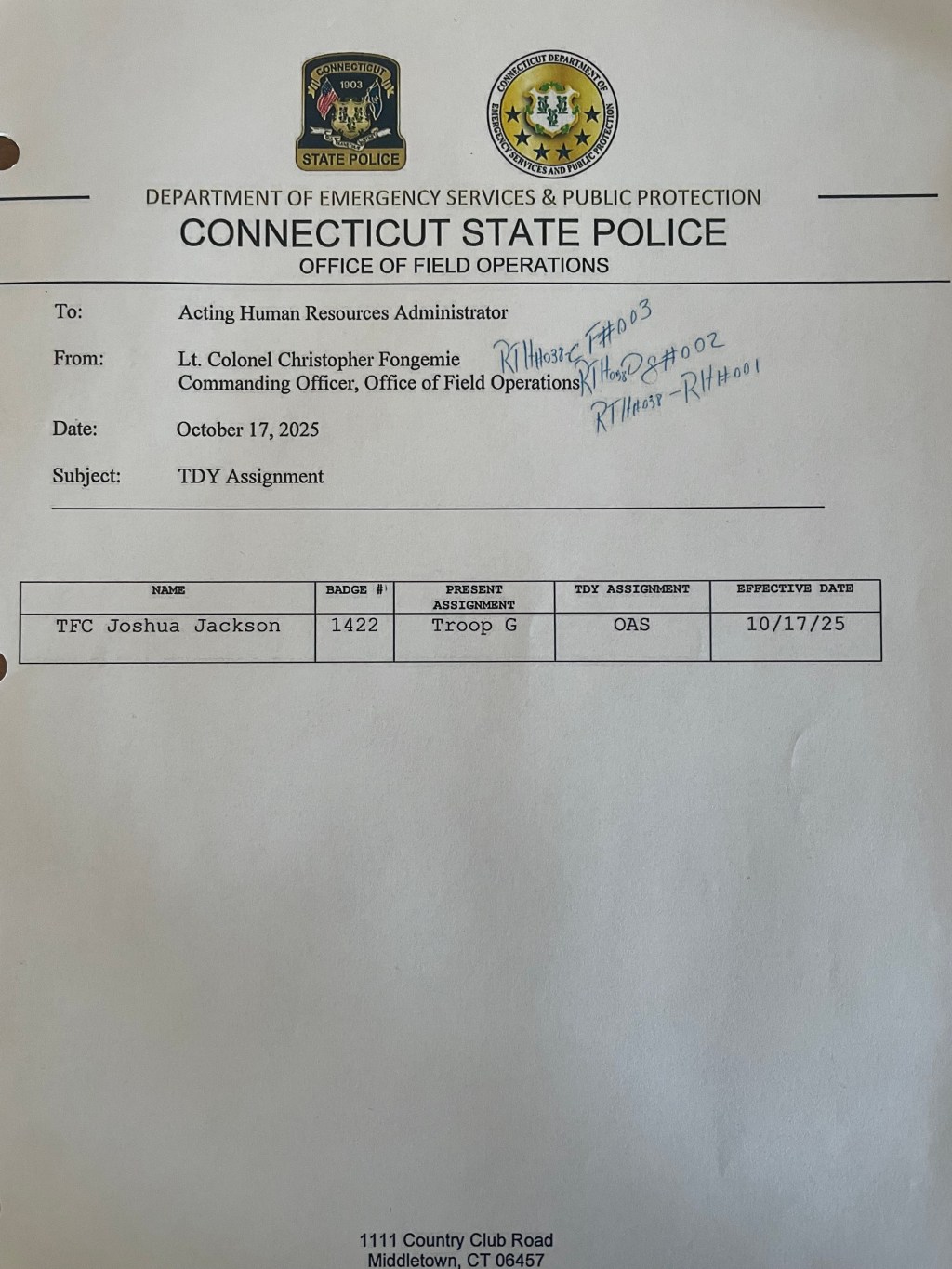
On the same day the complaint is dated, Trooper First Class Joshua Jackson was ordered to leave his barracks in Bridgeport and report to State Police headquarters in Middletown to sit at a desk, where he remained for three months before the IA investigation cleared him of any wrongdoing. The same-day transfer not only violated the state police union contract but also cost tens of thousands in restitution and overtime.
According to that complaint, the call came from “the State’s Attorney General’s Office,” although that is disputed by both the Attorney General’s Office and the State Police.
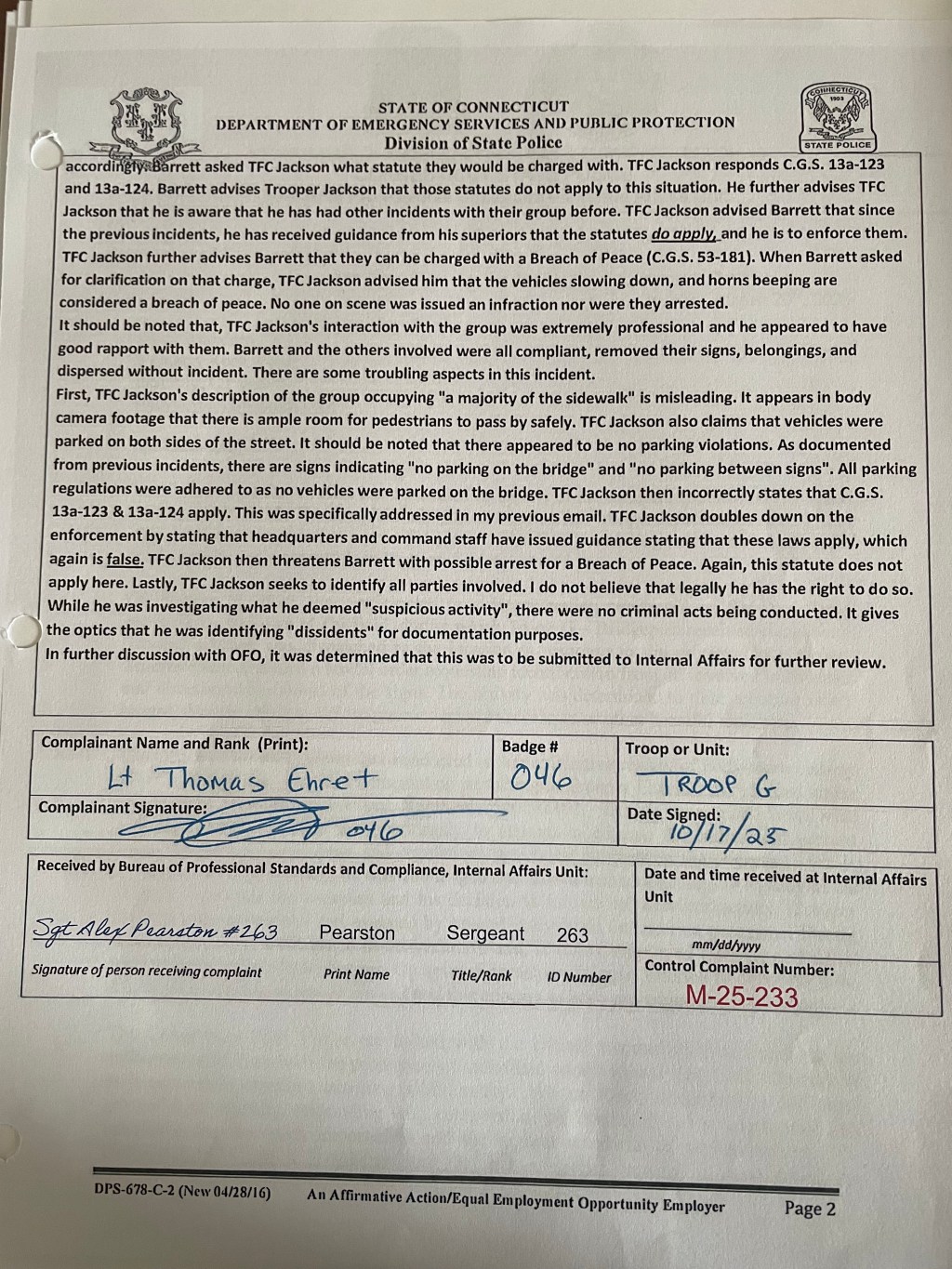
“On 10/16/25, I was notified by LTC Fongemie that the Colonel had received a call from the State’s Attorney General’s Office indicating there was another recent incident between TFC Jackson #1422 and a group of protesters,” wrote Lt. Thomas Ehret in his 10/17/25 internal agency complaint submitted to the Internal Affairs unit. “That evening, I searched the RMS system and checked for BWC footage from TFC Jackson and noted that Colonel Loughman was correct.”
The Attorney General’s Office has denied any knowledge of this alleged phone call and speculated that Ehret meant to write “the State Attorney’s Office.”
The Connecticut State Police initially ignored numerous questions sent by Inside Investigator and finally responded one week past deadline, saying the complaint pertained “to communications between the Connecticut State Police and the Office of the State’s Attorney, not the Office of the Attorney General.” However, they offered no further information and did not answer any follow-up questions.
“As the internal investigation has concluded and the matter is closed, no further follow-up will be provided regarding this incident,” CSP Media Relations Captain Katherine Coney wrote.
Emails and phone calls to the Office of the State’s Attorney to confirm this phone call were not returned.

The phone call came amid tensions between state and local police and anti-Trump protesters on highway overpasses where, according to state statute, signs could not be displayed or hung.
State police said they were following the law during these interactions; the protesters claimed it was politically biased harassment and a constitutional violation. The ACLU eventually filed a federal lawsuit alleging Connecticut’s laws regarding signage and protests on highway overpasses conflicted with free speech rights.
TFC Jackson had become the name most associated with police interference in those protests, largely organized by the “Visibility Brigade.” News articles, politicians, press releases, and even some of the protesters themselves falsely claimed that Jackson had arrested the Visibility Brigade’s leader, Katherine Hinds, twice.
And despite multiple state troopers and local police departments interacting with and dispersing overpass protesters, Jackson was the only state trooper or police officer identified by name, no less than five times, in the ACLU’s lawsuit.
The unprecedented rapidity of Jackson’s transfer, combined with several false statements made in the agency-generated complaint to IA, raises serious questions as to political interference in state troopers doing their job, enforcing laws that carry political implications, and whether some individuals in the highest ranks of the Connecticut State Police ignored easily verifiable facts to punish a trooper at the behest of some higher office.
If Jackson’s September 26 interaction with those protesters was problematic, why did it take three weeks for State Police management to take any action in the form of an agency-generated complaint? Why is the Attorney General’s Office noted as the source of the IA complaint when the AG’s office claims no such phone call ever occurred? Why would the Office of the State’s Attorney be involved when no citation or arrest was made during that interaction? And why was Jackson transferred so quickly just one day before the October 18, 2025, No Kings protest?
Neither the State Police nor the Office of the Attorney General nor the Office of the State’s Attorney are saying much.
According to the October 17, 2025, internal complaint, TFC Jackson “dispatched himself” due to a “suspicious incident” on a highway overpass where roughly fifteen people were “displaying large banners visible to traffic on Interstate 95 in both directions,” on September 26, 2025.
The report goes on to describe Jackson’s interactions with the protesters, during which he asks them to leave the overpass citing traffic and safety concerns, and has an extended conversation with one protester, John Barrett, who spoke for the group. Two other state troopers and the West Haven police also arrived on the scene. Jackson warned the protesters not to return, or they would be “charged accordingly.” The protesters dispersed without further incident. No arrests were made and no tickets were issued.
In the IA complaint, Lt. Ehret writes that “Jackson’s interaction with the group was extremely professional and he appeared to have a good rapport with them,” but goes on to claim that Jackson violated guidance that both Lt. Ehret and the State Police training academy had issued regarding how to interact with protesters on highway overpasses.
All of this, along with Ehret’s assertion that Jackson had “self-dispatched” to the scene, was refuted by the Internal Affairs investigation, which did not come out until January 28, 2026.
“The inquiry established that TFC Jackson was lawfully dispatched by Troop G desk personnel in response to reports of protest activity and potential traffic disruption,” wrote Sgt. Alex Pearston of the Internal Affairs Unit. “Review of NICE audio recordings and CAD entries confirmed that he did not self-dispatch and responded in accordance with established procedures.”
Regarding whether Jackson violated the guidance previously issued by the department and training bulletin, the IA review again found no misconduct on Jackson’s part.
“Although his statutory interpretation differed from specific guidance contained in Training Bulletin #2025-022, the investigation determined that he acted in good faith and exercised reasonable professional judgement in addressing an immediate safety hazard. No arrest or citations were issued,” Pearston wrote. “Body-worn camera footage confirmed that TFC Jackson conducted himself in a professional, respectful, and controlled manner throughout the interaction. No evidence was identified indicating misrepresentation of conditions, improper identification procedures, abuse of authority, or retaliatory conduct.”


According to the State Police collective bargaining agreement, Troopers “shall be notified no less than two (2) weeks prior to the transfer date,” when they are to be transferred from one barracks to another so they can prepare. Disciplinary transfers are to be done in accordance with “just cause” standards, meaning State Police management would have had to establish a record of disciplinary issues and warnings. Jackson had no prior discipline, and his evaluations were positive.
Nevertheless, the very same day Lt. Ehret – at the direction of Col. Loughman and Lt. Col. Fongemie – submitted the IA complaint, Jackson was assigned from Troop G to the Office of Administrative Services at the Department of Emergency Services and Public Protection headquarters effective immediately, according to a notice sent that day by Fongemie.
That rapidity of transfer was only matched when Jackson was transferred back to his original barracks the day after IA released their report finding he had done nothing wrong, and a grievance settlement was reached between the state police union and DESPP that resulted in a large payout to Jackson.

“HARASSMENT”
Jackson’s interaction with protesters occupying highway overpasses on September 26 was far from his first encounter with the Visibility Brigade during his patrols on I-95. He was dispatched to highway overpass protests on February 14, April 24, and August 6 – often in conjunction with local police responding to 911 calls – all cases where protesters were dispersed without tickets or arrests.
“Connecticut law prohibits attaching unauthorized signs on state highways, bridges, and overpasses, prohibits individuals from intentionally or recklessly obstructing traffic on the roadways, and prohibits the intentional blocking of public sidewalks,” DESPP Commissioner Ronnell Higgins wrote in an August 19, 2025, letter to Sen. Bob Duff, D-Norwalk, and Rep. Anne Hughes, D-Reddington. “Collectively, these laws recognize that certain activities along our busy highways may pose a safety hazard by obstructing visibility or distracting motorists, thereby creating a risk of accidents.”
Duff and Hughes had written to Higgins to express concerns that highway overpass protesters were being targeted and harassed by state troopers for their political beliefs and trampling on their First Amendment rights, something Higgins roundly rejected.
“The Connecticut State Police recognize that individuals have constitutionally protected rights to engage in free speech, including peaceful demonstrations with signs and posters in public areas. While these rights are firmly protected, they may be subject to reasonable time, place, and manner restrictions, particularly in areas adjacent to high-speed travel lanes or critical infrastructure, when necessary to ensure public safety and security,” Higgins continued. “I reject any assertation that Troopers are unfairly targeting certain overpass protesters based upon any perceived political or social affiliations.”
However, the February 14 and April 24 interactions between Trooper Jackson and the overpass protesters spurred a complaint by organizer Katherine Hinds, who disputed the legality of not allowing the protest on the overpass and claimed, “Jackson’s behavior was harassment and, we believe, a violation of our constitutional rights.” The complaint resulted in an IA investigation.
In their May 9 letter to Hinds, Sgt. Alex Pearston of the Internal Affairs unit informed Hinds that Jackson had behaved according to state police standards, and that she had knowingly violated instructions by a state trooper to not return to the overpass and not to affix signs to it. Pearston noted that, “Jackson again utilized his discretion, and no enforcement action was taken.”
The letter goes on to note the relevant statutes and regulations barring people from attaching signage to overpasses and the use of overpasses, and found that Jackson had done nothing wrong.
“During your interaction with TFC Jackson, you exhibited a consistently critical demeanor toward his lawful authority, engaged in disrespectful and interruptive behavior, and contributed to the unnecessary prolongation of the encounter,” Pearston wrote. “TFC Jackson provided you with multiple opportunities to speak, all while maintaining a composed demeanor.”
Jackson was not the only trooper to catch a complaint due to interactions with protesters on highway overpasses; a complaint submitted by phone on August 14, 2025, alleged Trooper Jonathan Elterich “directed a rude, condescending, disrespectful, and aggressive tone,” toward an overpass protester.
Again, IA found the trooper had been dispatched to the location, issued lawful orders, and directed the removal of signs. According to Pearston’s August 20 letter, body worn camera footage showed Elterich being repeatedly challenged and questioned regarding the legality of his orders by several different protesters, that caused frustration and “prolonged the interaction.”
However, it was the arrest of Hinds in July 2025 that began to draw public attention to the interactions between the protesters and state police, resulting in media reports that incorrectly asserted that Jackson had arrested Hinds twice and possibly put a political target Jackson’s head.
Jackson wasn’t present for Hinds’ first arrest, nor had he ever arrested a protester or even given them a citation at that point.
Hinds had, in fact, been arrested on July 19, 2025, in West Haven after troopers were dispatched in response to a 911 call. According to the arrest report, Hinds was arrested by Trooper Luis Morales for repeatedly returning to the overpass and displaying banners after she had been given a lawful order by Jackson in April not to return.
According to the July 28, 2025, arrest report, Morales arrived at the West Haven overpass in response to 911 calls and was joined by Trooper Forrow. Katherine Hinds identified herself as the organizer.
“The activity was causing a significant distraction to passing motorists, resulting in vehicles slowing down and frequently honking. The conduct was deemed to constitute a hazardous (sic) to the traveling motorists on I-95 as the group in question were intentionally trying to gain the attention of the motorists below,” Morales wrote. “Hinds was previously advised that she could not be in that location and she returned without permission. Hinds also displaying a banner on State Property without the required permits. The prior warnings and the ongoing safety risks associated with her actions, Hinds was taken into custody without incident.”
Hinds was charged that day with second degree breach of peace, second degree criminal trespass, and unauthorized signs on highway property.
However, upon seeing that she had been arrested once again for the same activity he had repeatedly warned her about, Jackson found Hinds posting on social media about other protests on overpasses. He used that information to secure an arrest warrant that was approved by his supervisor and signed by Judge Eugene R. Calisto Jr. and prosecutor Thomas Bransfield. Hinds was then arrested by Jackson at her home on July 30.
The resultant media coverage throughout August prompted lawmakers to start reaching out to DESPP Commissioner Higgins, claiming that free-speech rights were being trampled and state troopers were interfering for political reasons.
All the charges against Hinds were eventually dropped in October, roughly a week and a half after that phone call was made by either the Attorney General’s Office or the Office of the State’s Attorney informing Colonel Loughman, “that there was another incident between TFC Jackson and a group of protesters.”

“HOT BUTTON TOPIC AT HEADQUARTERS”
At the time of the alleged phone call, Connecticut state officials had just been presented with a federal lawsuit filed on September 18 by the Connecticut ACLU on behalf of two protesters, Erin Quinn and Robert Marra, who alleged Department of Transportation Commissioner Garrett Eucalitto and DESPP Commissioner Ronnell Higgins were violating their First Amendment rights through state police interference at protests and listed the various incidents between overpass protesters and state and local police.
Neither Quinn nor Marra had ever been arrested or issued a citation during their participation in the overpass protests. However, they were present when state police, including Jackson, had ordered the signs removed and protesters to leave the area, and they were present when Hinds was arrested by Trooper Morales, causing them fear that they, too, would be arrested and thereby chilling their free-speech rights.
While the court complaint generally lists “state police,” or local police departments that showed up to the protests, Jackson is the only trooper identified by name, five times throughout the complaint, despite having never issued a citation or arrested someone during those interactions on the overpasses.
“For the plaintiffs, Ms. Hinds arrests were the last straw,” ACLU Attorney Dan Barrett wrote in the court complaint. “The fear that if they continue to hold signs, they too will be arrested. As the primary caretaker of two children, Ms. Quinn feels she can no longer tolerate the risk of being harassed or potentially arrested by police for her protest activities. Mr. Marra similarly feels that the variability of the police response to the demonstrations, and reasoning given, means anything could happen.”
The ACLU attorneys argued that Connecticut’s statute banning erection of outdoor advertising or signs within one hundred and sixty feet of the edge of the right-of-way was being “broadly interpreted by its implementing regulations,” so that the word “sign” can mean anything from a massive billboard to a poster, and “erect” can range in meaning from constructing a sign to “attach, create, paint, draw, or in any other way bring into being or establish,” according to the court complaint.
The ACLU also alleged the law and regulations were not being applied fairly, pointing out the various billboards that line highways, as well as giant American flag displays hung from overpasses, something that is generally done when there is a death in law enforcement or emergency services, and protests during President Obama’s administration.
“However, interpretation and enforcement of Defendant Eucalitto’s sign statutes is, most charitably, inconsistent,” Barrett wrote. “In terms of displaying signs on overpasses, for example, protesters have displayed – or even affixed – signs on overpasses without incident. During President Obama’s tenure, protesters dissatisfied with the federal government’s actions erected signs along the Howard Avenue overpass in New Haven.”
The Attorney General’s office acts as the state’s lawyer and represents state agencies in lawsuits; however, the state of Connecticut and the AG’s office weren’t making much of a case defending their own laws and regulations.
Assistant Attorneys General Owen R. Eagan and Terrance M. O’Neil moved to dismiss the suit against Eucalitto because, as DOT Commissioner, he has no purview over enforcing Connecticut’s laws. They moved to dismiss the case against Higgins under the claim of sovereign immunity.
The Assistant Attorneys General also argued that the letter Higgins had written to Sen. Duff and Rep. Hughes, along with a training bulletin that was issued to troopers on how to handle overpass protesters, meant protesters didn’t need to worry any longer about state police interference and their concerns had been addressed, calling it “a case without controversy.”
It was the same training bulletin that Lt. Ehret alleged Trooper Jackson had violated when he interacted with protesters on September 26, along with an email Ehret had sent to all troopers on August 19, the same day that Commissioner Higgins issued his letter to Duff and Hughes.
None of those documents contain orders, but merely guidance, and some of them conflict with each other and with assertions made by the state in its defense.
On the same day Commissioner Higgins sent his letter to Sen. Duff and Rep. Hughes, Lt. Ehret sent out a mass email addressing the same topic but offering a substantially different viewpoint: where Commissioner Higgins reiterated Connecticut laws and regulations regarding unauthorized signs, along with noting there are limitations on where protests can occur due to safety concerns, Ehret’s emailed guidance to trooper barracks indicated that CT DOT wasn’t particularly concerned with protesters on the overpasses and that it wasn’t appropriate under state statute to issue infractions for the protest signs.
Ehret’s email begins with noting that it has “become a hot-button topic at Headquarters,” and that multiple phone calls, emails, complaints, and various FOI requests have been fielded by the office related to the protests, before writing that because of freedom of speech, “we must allow protest activity as long as protesters are not actively committing crimes.”
“While the Department of Transportation prefers signs not be hung on overpasses, their concern lies primarily with signs dangling over traffic, which can create a roadway hazard,” Ehret wrote. “If protesters are securing signs on the inside of the overpass fencing or railings – similar to American flags often seen – no enforcement action should be taken.”
“Issuing infractions under [the unauthorized signs statute] in these cases is not appropriate,” Ehret continued. “It does not apply to protest signs, flags, or other general messages placed on overpasses.”
According to his August 19 letter, Commissioner Higgins had asked the Connecticut State Police Training Academy to review the matter and issue a training bulletin. That bulletin came on September 16, ten days before Jackson was dispatched to the overpass protest that would eventually get him reassigned.
The bulletin reiterates that state law “prohibits attaching unauthorized signs on state highways, bridges, and overpasses,” and goes on to repeat the DOT’s regulations, indicating that a single sign “might not create a significant risk while multiple large and bulky signs might require action,” and addressing traffic concerns, noting that “several recent overpass protests have caused drivers to call 911 to report dangerous conditions.”
The general message of the bulletin, however, appears to leave the matter to troopers’ discretion, often offering guidance that lacks definition.
For instance, writing that protest activity should be allowed as long as protesters “are not actively committing a crime,” the bulletin then states that affixing signs to the overpasses is against the law, and troopers “must use their discretion and take appropriate action based on specific facts and circumstances of each case.”
“Protesters are often seeking media attention and, in some cases, grounds to file complaints. Do not give them cause. A Trooper is expected to provide a clear and lawful basis for his or her actions, not engage in lengthy debates around the multifaceted legal contours of the First Amendment,” the bulletin states. “If a crime has been committed or if a lawful order is disobeyed, enforcement action is warranted. Just ensure the order you give is lawful.”
The Attorney General’s Office used this training bulletin as part of their defense argument, stating that the bulletin rendered any concerns by the plaintiffs moot because it said they are, in fact, allowed to protest on the overpasses, “subject to the reasonable direction and control of the police.”
“Coincidentally, on the same day the Plaintiffs filed this action and a few days prior to service thereof, the State Police issued guidance to its troopers regarding highway overpass protests, and this guidance confirms what the Plaintiffs believed to be in doubt: that they are legally allowed to be present on highway overpass sidewalks in order to participate in free speech protest activities there, subject, as all protesting and non-protesting people are, to the reasonable direction and control of the police in pursuit of standard public safety goals,” Eagan and O’Neil wrote. “Plaintiffs allege lasting effects (i.e., some nervousness about spending time protesting on overpasses) of witnessing a discrete and context-specific criminal enforcement action. Each of those enforcement actions, however, operated based upon independent, situation-specific findings such as reasonable suspicion or probable cause.”
The Assistant Attorneys General then argue that in each of the cases in which protesters were subject to an enforcement action, the action was justified, which would, presumably, include both enforcement actions taken against Katherine Hinds.
The judge denied both the state’s motion to dismiss and the ACLU’s request for an injunction because by early February 2026, the two parties had already reached a settlement agreement.
The lawsuit would be stayed for two years, during which the state police could not use eight different state statutes — including criminal trespass, disorderly conduct, and unauthorized signs — to “detain, identify, threaten, fine, disperse, or arrest individuals for peacefully assembling or for holding up signs conveying non-commercial, political messages.”
Commissioner Higgins then issued the order to state troopers on February 20, 2026.
It was a quick turnaround for a federal lawsuit against the state. The same AG’s office whose attorneys fought for six years in court to withhold release of video showing the beating death of J’Allen Jones by correction officers and went so far as to allegedly mislead the court defending a lawsuit against the state’s energy regulator, agreed not to enforce certain state laws against individuals engaged in a particular activity within a mere five months.
Despite the tacit admission in the settlement that the laws regarding signage on highway overpasses and enforcement of them are a violation of free-speech rights, there has been no effort in the General Assembly to revise the laws and regulations to align with constitutional rights, ensure law enforcement can properly enforce the law, and potentially avoid another lawsuit in the future.
A February 18, 2026, press release announcing the settlement was posted to Sen. Jorge Cabrera’s, D-Hamden, legislative webpage that once again falsely asserts Hinds was arrested by the same trooper twice.
“I’m thrilled, I’m relieved, and I’m so grateful to the ACLU and to all of the state legislators who assisted on this – and Jorge is right at the top of the list. They all stood up for the first amendment, and I couldn’t be more grateful,” Hinds said in the press release. “This agreement is a win-win. It applies to everyone in the state.”

“ATTORNEY CLIENT RELATIONSHIP”
The directives issued by Higgins on August 19, 2025, the training bulletin issued September 16, 2025, and the AG’s defense offered troopers a, perhaps, legal distinction without much of a difference for either the troopers or the protesters when it came to handling face-to-face issues, until the state’s settlement with the ACLU in February 2026.
According to those directives, protesting on overpasses remained technically illegal, but troopers should use their discretion, and enforcement action is warranted if a crime has been committed or a lawful order disobeyed.
In Hinds’ case, her arrest by Trooper Morales and subsequent arrest by Trooper Jackson were both based on failure to follow the lawful order given by Jackson on April 24 that she not return to the bridge. In the case of the September 26 protest that involved fifteen people, no enforcement action was taken; the protesters simply received a warning and removed their signs, so the cause of the complaint to IA remains questionable.
As quickly as Trooper Jackson was removed from Troop G and placed at a desk at headquarters, he was returned to his original barracks. Internal Affairs issued their findings clearing him of the allegations made in Ehret’s complaint on January 28, 2026, and he was ordered back to the barracks on January 29.
According to the grievance settlement between the State Police Union and DESPP, Jackson would be compensated three T-days per week for every week that he worked at headquarters. T-days are essentially days off given to a trooper that can be cashed out as part of their pay; in this case, $22,000 in pensionable pay.
However, his removal from Troop G also meant his shifts had to be covered, resulting in more overtime at an agency that is already paying out more overtime than ever before. Based on schedules and pay rates, covering Jackson’s shifts likely resulted in roughly $45-$50,000 in additional overtime costs.
Between Internal Affairs’ findings and the grievance settlement, it is clear that the allegations made in the agency-generated complaint and the subsequent same-day transfer of Jackson were, at best, mistakes and, at worst, false allegations made to justify Jackson’s removal from his usual patrol routes.
The question as to who made that phone call, and why, remains.
According to the complaint, a call was placed to Col. Loughman by the “State’s Attorney General’s Office” regarding Jackson’s interaction with overpass protesters three weeks prior; then Loughman passed down orders for Lt. Ehret to investigate the matter and determine if action was warranted, and Jackson was moved. All of this took place in less than twenty-four hours.
The Attorney General’s Office claims to have no knowledge of any phone call made to Col. Loughman regarding Jackson or the overpass protesters, the Office of the State’s Attorney won’t confirm or deny, and, despite Inside Investigator sending numerous questions, State Police would only indicate that any such communication would be a matter of attorney-client privilege.
“The Connecticut State Police has an attorney-client relationship with the Connecticut Office of the Attorney General. The Department of Emergency Services and Public Protection and the Connecticut State Police do not take direction from Connecticut Office of the Attorney General in regard to operational matters.” Captain Katherine Coney wrote. “The Connecticut State Police maintains an ongoing and collaborative working relationship with the Office of the State’s Attorney as part of its regular daily operations.”