


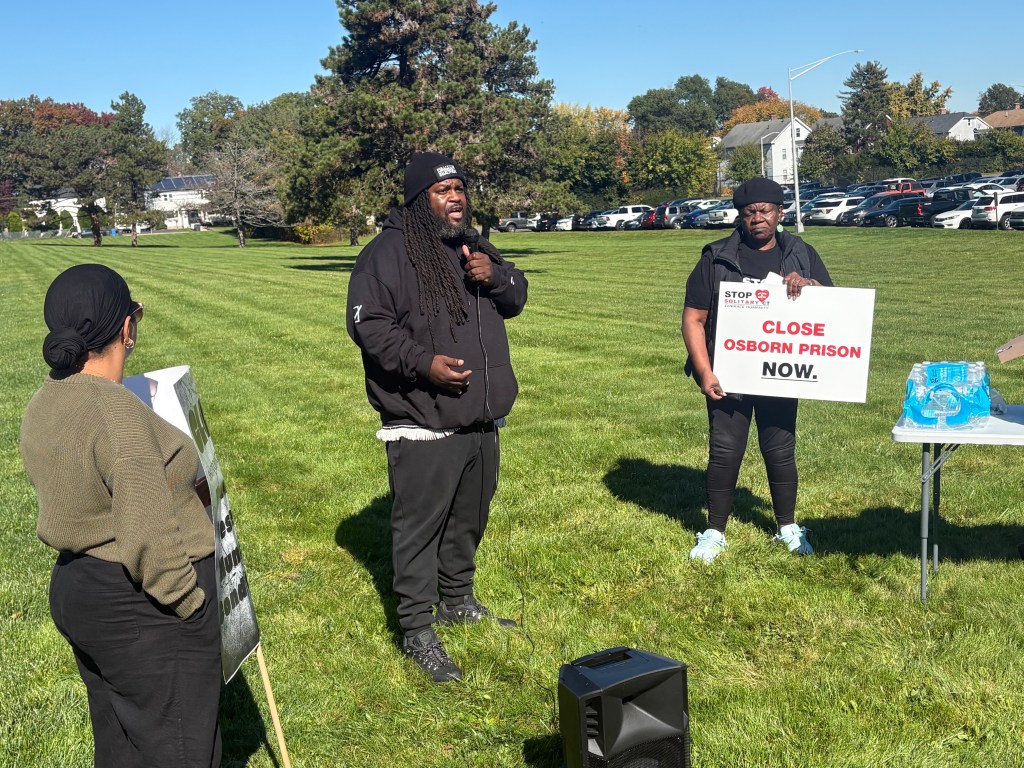
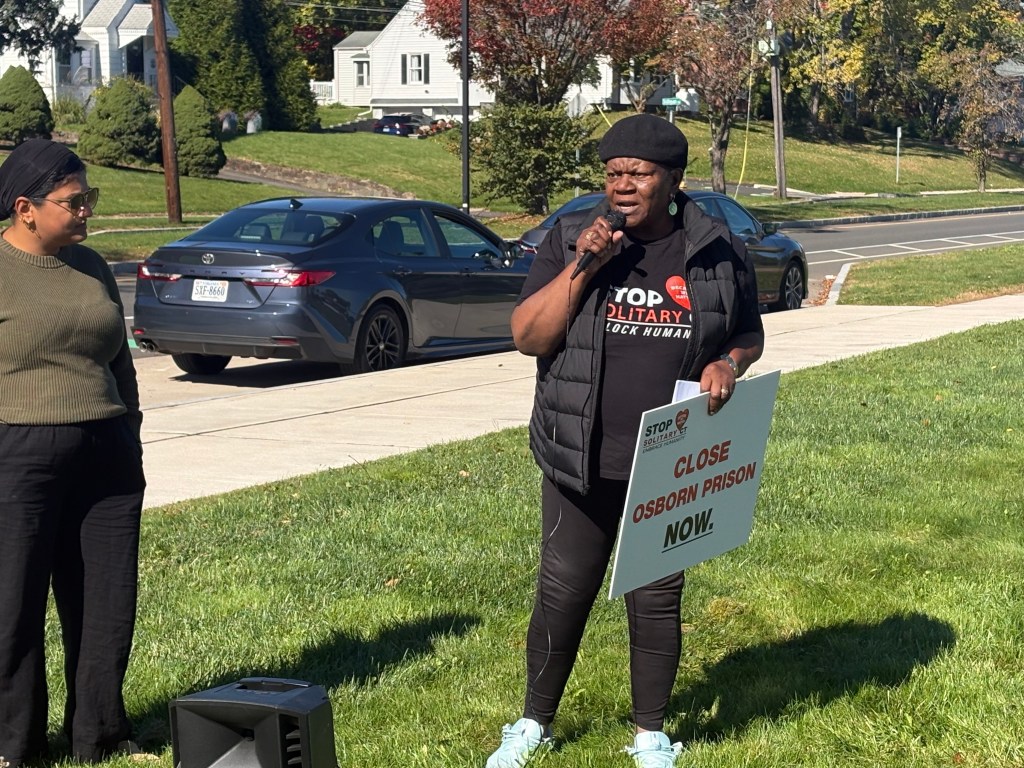
Yesterday, a group of prison rights advocates held a protest on the lawn of the Department of Corrections’ administrative headquarters in Wethersfield, demanding state officials close Osborn Correctional Institute. Osborn is a medium-security prison located in Somers that was originally opened in 1963. For nearly two decades, Osborn’s residents and their families have decried the prison’s conditions.
“Osborn needed to be closed 25 years ago,” said James Jeter, co-founder and director of the Full Citizens Coalition. “We need to hold everybody accountable — from the Attorney General down — for covering up the atrocities that have taken place in Osborn, and there needs to be a closing date.”

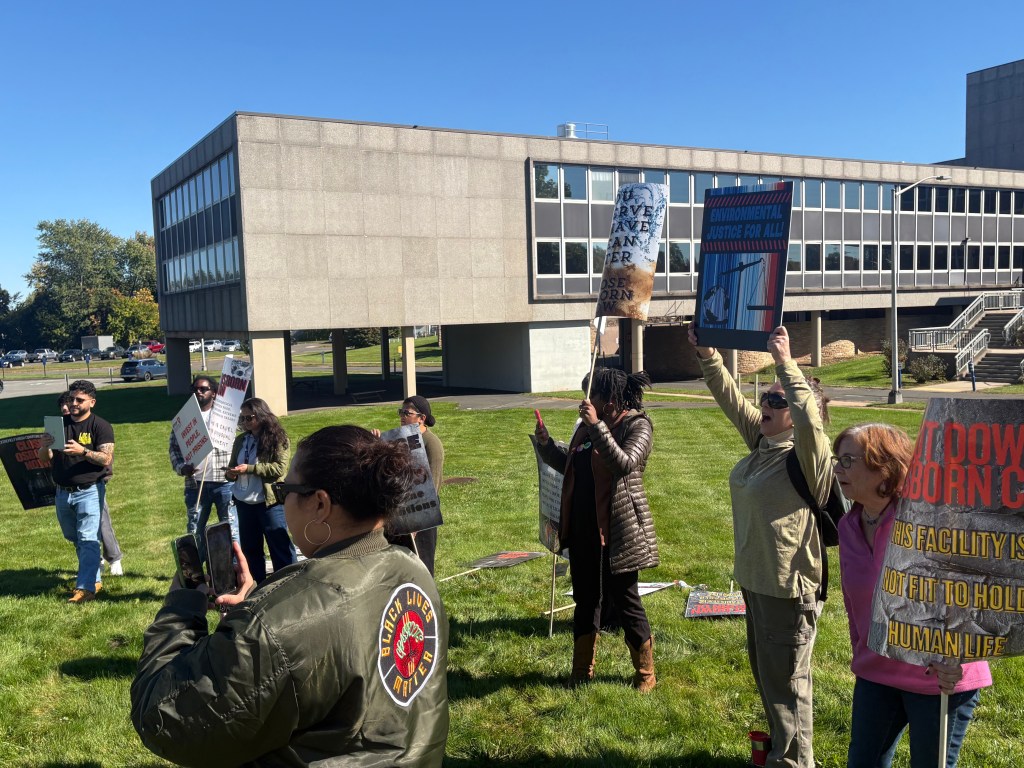

Opened in 1963, Osborn is the state’s oldest prison, built to house up to 1,900 men. For decades, the facility has been decried for having outdated facilities and infrastructure, a lack of clean water, unsanitary living conditions, neglectful medical staff, and a lack of central air conditioning. Jeter said his brother lived in Osborn from 2002 to 2006 and suffered from the facility’s lack of clean water.
“He came home with rashes from having to shower in the water,” said Jeter.
Joining Jeter was a litany of familiar faces in the world of Connecticut prison reform: Barbara Fair, of Stop Solitary CT; Ivelisse Correa, of BLM 860; Nancy Peters, of Brothers and Sisters United in Action; and Ana Escobedo, of CT People’s Survival Program, all of whom spoke at the event. Peters read aloud letters sent to her by men incarcerated at Osborn, who shared their own experiences with the unsafe water. One man wrote that despite living in Osborn for only a year, he has experienced “three different water crises.”
“The water smells like sewer water next to a zoo,” read Peters.
Per one letter, Osborn’s inmates were forced to drink water out of their sinks or get water from the mop closet, while Osborn’s COs and staff brought in their own bottled water to drink.
“My first time, they gave us water bottles for about four or five days because the water wasn’t safe for human consumption,” read Peters. “Then, when we asked to just continue to be given water bottles because the water still is stinking — coming out a dirty brown color, which is changing the color of our plastic cups like coffee stains — they told us the water was safe to drink, although they’re still not drinking the water, because they bring in water jugs or bottles from home. It became so bad, I had to force my nose to just refuse how bad it smells.”
In another letter written to Peters, it was said that sewage would often flow from one cell’s toilet to another, and that “cells are constantly breaking down without any fix to the problems.” Fair highlighted that Osborn’s water supply is just the beginning of its issues.
“Not only do we have water problems, we have electrical problems, have structural problems, we have mice and rats running around like they own the place,” said Fair. “A lot of disease and sickness comes out of that building.”
Osborn’s history of environmental and infrastructural hazards has been documented repeatedly. In 1986, water testing revealed an elevated level of tetrachloroethylene, a toxic chemical used in laundry detergents, in Somers’ groundwater. In 1994, a group of Somers residents sued the DOC and the Department of Environmental and Energy Protection (DEEP) after they discovered the contamination was due to over 30 years of improper disposal of the chemical by Osborn’s staff. Later tests also uncovered elevated levels of chlorobenzene, a chemical used in paint thinners, in Osborn’s groundwater, caused by poorly managed runoff from Osborn’s furniture industry, said Jeter.
In 2011, state officials discovered the presence of elevated PCB levels in Osborn’s building materials. In 2017, Jose Pesante, who was formerly incarcerated at Osborn, sued DOC for allegedly exposing him and other prisoners to PCBs, asbestos, and contaminated drinking water. The suit revealed that prison officials buried their initial discovery of the PCBs and waited until 2016 before meaningfully remediating the affected areas. In 2019, another group of Osborn inmates sued DOC, alleging that Osborn’s drinking water was contaminated with sewage. In August 2024, the prison’s water main broke entirely, leaving prisoners with insufficient access to drinking water, a situation made worse by the prison’s lack of central air conditioning.
DeVaughn Ward, the state’s Correctional Ombudsman, has also documented Osborn’s dismal living conditions. In October 2025, his office released a Heat Mitigation Report, finding that Osborn residents endured dangerous heat while having restricted access to showers or laundry. In January 2026, Ward’s Conditions of Confinement report revealed the presence of dead mice and instances of medical neglect at Osborn. In March, the prison experienced a 24-hour lockdown after the water main broke yet again. After visiting Osborn in July, Ward told reporters that the prison was “a facility beyond its useful life.”
It is with this history in mind that Connecticut’s prison reform advocates have renewed their demands for Osborn’s shuddering. State Rep. Maryam Khan (D-Hartford), who is currently running for Hartford’s State Senate seat, also expressed her support for closing the prison.
“It is completely uninhabitable, and it should not be inhabited by people,” said Khan. “Whatever it is that we need to do, whomever we need to talk to, I would lend my voice and hope to be there with you all.”
Correa-Brown and Fair called on the state to move Osborn’s residents to other facilities. Correa-Brown recommended that the state reopen recently closed facilities, such as Gates and Bergin CI, which were closed in 2011, and Enfield CI, which was closed in 2018, to facilitate this move.
“We can reopen them, make them safe, and transfer these men into housing appropriate for their classifications and needs,” said Correa-Brown. “I’m not here asking for another study or another temporary repair. It would be a better use of tax dollars to set it on fire than to spend another minute and another dollar investing into Osborne.”
While DOC has made a litany of piecemeal renovations and upgrades to Osborn’s facilities over the past two decades, advocates said the time for band-aid fixes has long passed. The latest band-aid fix for Osborn was made this summer, when DOC allocated $1.2 million to install 18 air conditioners.
“There’s still going to be units that have no air conditioning,” said Fair. “We have to push back on the bandages that they want to put on this system, and make sure that [they know] these are places where people — human beings — are there.”
Per Ward’s Heat Mitigation Report, DOC estimated that a full overhaul of Osborn’s HVAC system would cost $120 million. Jeter told Inside Investigator that the only excuse for state officials’ inaction in the face of Osborn’s many deficiencies was the prioritization of capital over humanity. He noted that Osborn is the site of the state’s largest Correctional Industries Program, which he believed makes relocation even less palatable.
“The idea of losing that or having to somehow restructure it elsewhere, which means building out a new facility. The human cost is collateral damage, right?” said Jeter. “It’s acceptable collateral damage for the state.”
Khan told Inside Investigator that the issue has “not got the attention it needs” among legislators, and admitted to not understanding “the degree” of the issues at Osborn until Escobedo made her aware of them. She supported the idea of opening a public hearing on Osborn next legislative session to “make a difference through power in numbers.”
“I’m one person, but getting more people to hear these stories hopefully will help,” said Khan.
Jeter expressly named Sen. Gary Winfield (D-New Haven) and Reps. Josh Elliott (D-Hamden), Toni Walker (D-New Haven), and Anthony Nolan (D-New London) as other lawmakers who have indicated interest in addressing Osborn’s deficiencies, and also said he’s found “support on the other side of the aisle.”
“This is about humanity; this is inhumane,” said Jeter. “There are legislators who will stand on this, it’s just, how do you get enough?”
Fair shared her own plan to do exactly that, announcing that another rally will be held at the State Capitol on November 16, at 12 p.m. She also said she would work with Khan to iron out a public hearing with legislators present, “so they can’t pretend they don’t know what’s going on.”
“We intend to continue to be visible,” said Fair. “We want to make sure that people in DOC realize we are serious about this. This has been a long fight, and I think it’s time for it to end.”