


The Northeast has the most restrictive childcare regulations in the country according to a new report from the Knee Regulatory Research Center at West Virginia University.
From Pennsylvania to Maine, states in the Northeast, with the exception of New Hampshire, New Jersey, and Delaware, have the most restrictive regulations in the country according to the report. New Hampshire, New Jersey, and Delaware fall into the bottom 75 percent of states with the most restrictive regulations.

The report ranks Connecticut forty-five out of fifty for states with the most restrictive childcare regulations. In New England, only Rhode Island, ranked forty-seventh, and Massachusetts, ranked fiftieth, scored lower.
The report looked at variables like the maximum group size allowed in daycare classrooms, child-staff ratios, the required annual number of training hours for staff, and minimum educational requirements for certain childcare staff and assigned states a score out of ten, with ten considered the most free and zero considered the most restrictive. Those variables were used because they are the four most common regulations across states.
Connecticut received a score of 2.2. The average was 4.47.
The report notes that more restrictive states also tended to be higher-population states.
It also noted that the variables used are “poor indicators of true quality” and that parents are “generally able to determine the value and level of quality on harder to evaluate metrics” because they regularly interact with childcare staff.
But, the report noted that even if the metrics don’t always correlate with childcare quality, they do “drive up cost considerably.”
“Childcare providers must invest in meeting the regulatory standards, which can involve hiring more staff, obtaining certificates, upgrading facilities or purchasing specialized equipment. These compliance costs are typically passed on to parents through higher fees.” the report noted.
The report also notes a correlation between how restrictive a state’s childcare regulations are and the fertility gap, which measures the difference between desired family sizes and actual fertility rates. On average, according to the report, the average gap in the U.S. is 0.8 children below the desired family size.
With the exception of Vermont, which had an average fertility gap, New England had an above average fertility gap.
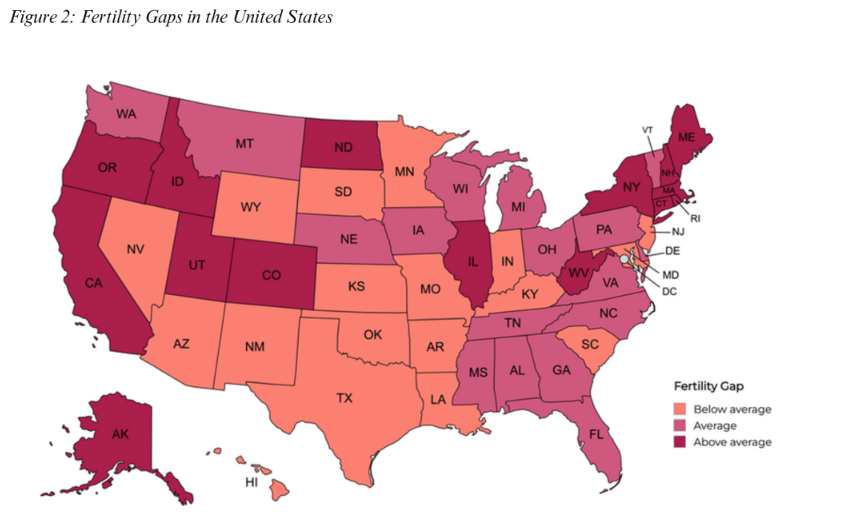
“The New England region generally demonstrates low index scores (most restrictive regulation) and above average fertility gap.” the report notes.
“The intuition behind these results is that regulations have a strong effect on affordability, flexibility, and availability of childcare options, not just their quality. The cost of an additional child is directly related to childcare and other financial costs for many families. Additionally, without childcare options that fit with parents’ work schedules or flexibility needs, parents in states with less childcare freedom might face a tradeoff between career and parenthood that has very little middle ground.” the report continues.
This, it notes, impacts women’s careers more and there is a correlation between higher fertility in states where women are able to have a career and multiple children and lower fertility in states where women face choices between whether to pursue a career or have children.
Licensing requirements and qualifications also affect individuals who might want to supplement their income by opening an in-home daycare, the report further notes.
The cost and availability of childcare has been a topic of concern among legislators and in Gov. Ned Lamont’s administration. Lamont commissioned a Blue Ribbon panel on Child Care via executive order in 2023. Most recently, in September the legislature’s Regulation Review Committee approved changes to student-teacher ratios for several age ranges. The move was expected to increase childcare capacity, which, according to Office of Early Childhood (OEC) Commissioner Beth Bye, was at 35 percent capacity of the number of spots needed for infants at toddlers in September.
Data from the OEC shows that the number of childcare spots and licensed programs has increased in recent years. In 2022, there were 3,292 licensed programs in the state with the capacity to serve 102,439 children, with nearly a quarter of that serving children under the age of three.
In 2023, the last year for which data is available, there were 3,359 licensed programs, with the capacity to serve 119,102 children. The majority of this increase, however, was for children over the age of three.
In February of this year, the United Way of Connecticut released a report stating that there were 40,000 open childcare slots in the state that were unable to be filled due to staffing shortages.
In September, Lamont signed legislation consolidating the state’s existing early childhood programs–Head Start, School Readiness, and Child Day Care–into one program, known as Early Start CT. The bill also expanded access to Care 4 Kids, which assists low- and moderate-income families with childcare costs.


