

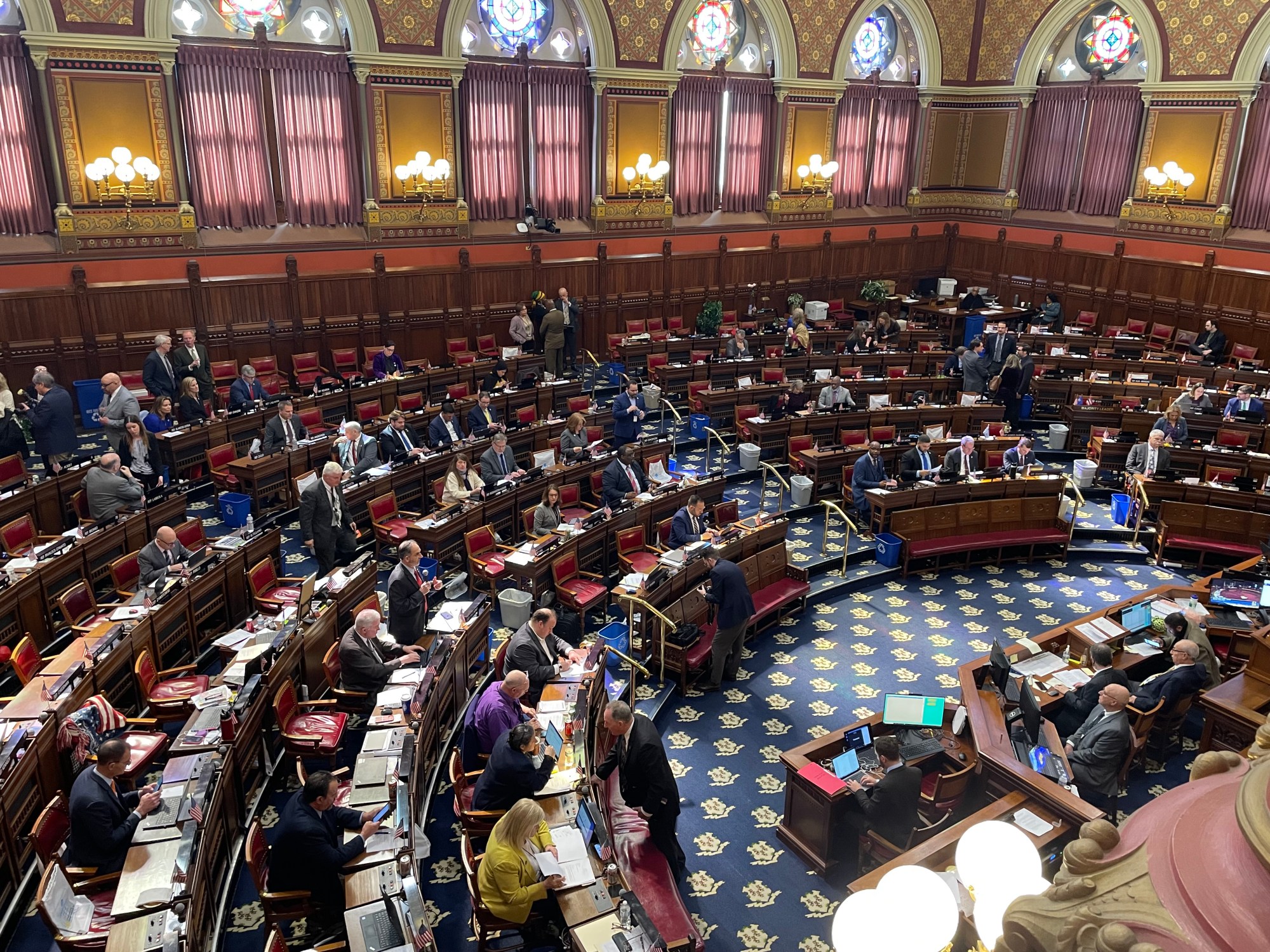
With end of session a day away, Republicans in the House of Representatives used their ability to run out the clock to change language in a massive energy bill that would have empowered the chair of the Public Utilities Regulatory Authority (PURA) Marissa Gillett to continue appointing herself as presiding officer in cases that come before the authority – an issue that is, in part, currently being litigated in superior court.
An amendment offered by co-chair of the Energy and Technology Committee Sen. Norm Needleman, D-Essex, to Senate Bill 4 – An Act Concerning Energy Affordability, Access and Accountability – included language stating “the chairperson of the authority shall be the administrative head of the agency.”
However, a bipartisan amendment that was adopted and passed by the Senate changed that passage. According to the new language, “the chairperson serves as the chief executive of the authority for administrative purposes.”
That minor difference is tied to the definition of “presiding officer” in Connecticut’s Uniform Administrative Procedure Act, which states “presiding officer means that member of an agency or the hearing officer designated by the head of the agency to preside at the hearing.”
The concern for House Republican Leader Vincent Candelora, R-North Branford, was that designating the PURA chair as the “administrative head of the agency” in statute would, under the UAPA definition of presiding officer, allow Gillett to continue appointing herself presiding officer in cases that come before PURA.
According to current state statute, a case coming before PURA is assigned to a panel of three commissioners, who can then choose to appoint a hearing officer. Since there have only been three PURA commissioners – despite state statute saying the governor shall appoint five commissioners – PURA has said that Gillett “generally” designated herself as presiding officer in most cases.
However, while acting as presiding officer in those cases, Gillett issued motion decisions on substantive matters under the name of PURA’s executive secretary, giving the impression it was a decision by the full authority and not just the decision of a presiding officer, which can be appealed to a vote by the full panel.
In some cases, those motion decisions involved tacking millions onto ratepayers’ public benefits charges, or Gillett issuing a legal opinion that she was not biased against the utility companies and had not taken part in ex-parte communications. Those issues are currently being litigated in a rate gas brought by Avangrid’s two gas utility companies, and in a lawsuit brought by both Eversource and Avangrid claiming that PURA is violating state statute, in part, by allowing Gillett to issue these motion decisions on her own.
“The reason why it changed is the final version mirrors what is in regulation already,” Candelora said. “If she’s the presiding officer, then the panel doesn’t get to appoint the presiding officer, and that was my argument.”
“That’s the poison pill,” Candelora said. “I don’t want her presiding officer in every single case, I think it should be a panel.”
The “administrative head of the agency” language was the second attempt to alter the power dynamics at PURA in favor of the chairperson. An earlier draft version of the bill would have allowed the chairperson to designate or serve as the presiding officer and allow the presiding officer to issue motion rulings on behalf of the panel. It also would have allowed meetings between commissioners to occur without an official record – essentially enshrining in statute everything questioned by Superior Court Judge Matthew Budzik.
During a press conference, House Speaker Matthew Ritter, D-Hartford, denied knowing where the language came from, but indicated that PURA had a hand in crafting the legislation, along with many others, including the governor’s office. Ritter also said he didn’t want to move forward on the bill in the House without bipartisan support.
“That was not any senator or representative that submitted that language, I want to be very clear about that,” Ritter said during a May 30th press conference. “How it became that iteration was probably through nine thousand comments from a bunch of people, and we’re going to go back and try to fix it.”
That same day, Candelora said that language reigning in PURA’s authority kept getting taken out of the bill and indicated he would not back down.
“When you have an agency facing many lawsuits you should look to improve how that agency functions and try to take the temperature down and eliminate the problems,” Candelora said. “That has been my focus and unfortunately that language continues to get pulled out of that bill without any explanation as to why that agency shouldn’t be acting as a body of five instead of a body of one. So, that’s a non-starter for me.”
The latest amendment for SB 4 was offered by bipartisan legislative leaders, including Candelora, and passed the Senate nearly unanimously with only Sen. John Fonfara, D-Hartford, voting against the bill.
Fonfara, who has an acrimonious history with PURA, was reportedly offered a seat on the authority as part of a backroom deal between Democrats and the governor to get the chairman reappointment approved by the Executive and Legislative Nominations Committee. Under the reported terms of the deal, PURA would become a quasi-public agency so that Fonfara, as a sitting senator, could also be a commissioner. The bill language, however, keeps PURA under the Department of Energy and Environmental Protection, meaning Fonfara would be unable to take the job.
Both Ritter and Candelora indicated there was an understanding with the governor’s office that Lamont would appoint two more commissioners to PURA, as required by statute. Lamont has resisted previous calls to appoint the full five commissioners, saying it wouldn’t make a difference.
“We agreed to an understanding that the governor will make those two appointments by February 2026,” Candelora said. “He hasn’t made them in four years, he hasn’t given a reason why other than saying, ‘I like three.’”
“Laws matter. You have to follow the law. I don’t care what you like, it’s what you must do,” Candelora said. “If he doesn’t make those appointments next year, we will be back at it, fighting that issue all over again.”



Nice article, Marc, especially the behind the scenes coverage. I try to follow the energy stuff at the legislature and still learn something every time I read your articles.
Also kudos for being quoted in Kevin Rennie’s article in today’s Courant (page 20) for your exposing the governor’s staff vehicle issue last November.
People of CT cannot wait another year for the Republicans bring up PURA and energy bill. Saving us $200 a year on our electric bills is an embarrassment and will not put a dent on our enormous electric bills. While I commend the Republicans hard work on this, it is a great disappointment