

Though the Israel-Hamas War is half a world away, the impact is being felt close to home for many Jewish students at Yale University.
Since the onset of the war, on Oct. 7, 2023, Yale has been home to several pro-Palestinian protests, and some students say that they have been discriminated against.
Yale is currently being investigated by the federal Department of Education (DOE) for alleged failure to respond to antisemitism.
In a federal lawsuit, Jewish students at Yale claim they were harassed by fellow students and subject to disparate treatment from the University. They say that not only did Yale fail to protect them, but that some faculty members and administration facilitated a hostile environment.
The complaint was submitted to the DOE from the Louis D. Brandeis Center for Human Rights on behalf of Netanel Crispe, ’25, and Sahar Tartak, ’26, a former and current student at Yale University.
The complaint alleges that the University permissively allowed pro-Palestinian protestors to break rules on campus and harass Jewish students, while holding Jewish and Israeli students to different standards.
Independent of the DOE investigation, in October 2024, the U.S. House of Representatives’ Committee on Education and Workforce found that Yale “failed to impose meaningful discipline for those who engaged in antisemitic conduct.”
Yale University received almost $900 million in grants through the federal government in 2024. If the University is found to have violated Title VI, school officials will have to implement policy changes or risk losing that funding.
The lawsuit against Yale claims that, from the start of the Israel-Hamas war in October 2023, University rules were applied differently to students advocating or sympathizing with Jews and Israelis, and those advocating for Palestinian causes.
One of the first events mentioned in the civil rights complaint is an incident that happened a week after Oct. 7. Sahar Tartak, who represented residential facility Pierson College at the Yale College Council, had access to the College Council’s email listserv. In the past, this listserv had been used to advertise social events, including food drives and Halloween parties, but when Tartak sent an email about a Shabbat, or Jewish Sabbath, dinner being hosted by one of the campus Jewish organizations, Chabad at Yale, she was reprimanded.
In the email, Tartak wrote: “As many of you know, this has been a hard week for the Jewish community at Yale and across the world. The massacre of over 1,200 innocent lives in Israel has affected many Yalies directly, whether it means calling family across the world to check in or losing actual relatives and friends. So the Jewish community at Yale is choosing light over darkness and extending an invitation to all students, Jewish or not, to attend Shabbat dinner tonight.”
Hours after it went out, a Yale Dean and the Head of College Crystal Feimster reached out to Tartak and the other senator representing Pierson College, and told them to stop using the listserv until they could discuss “their use of the Pierson pan email list to send out information that is unrelated to council business.” There is a rule, which is not written in any student senator handbook, that the listserv cannot be used for social events, but Tartak’s lawsuit claims it had never been enforced until then.
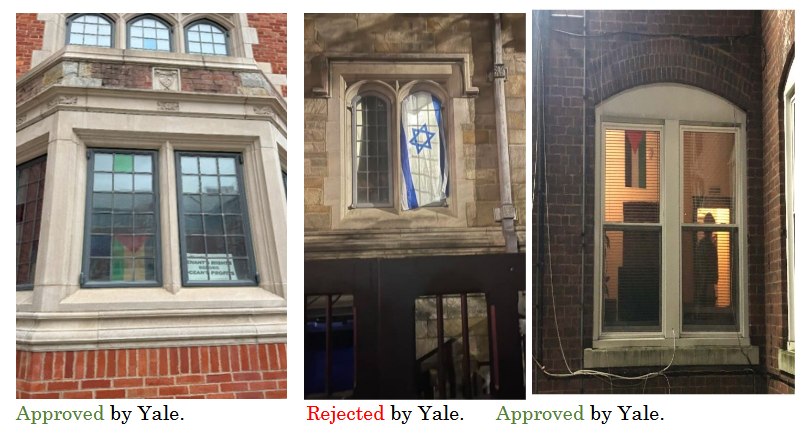
A few days after Tartak was reprimanded for using the listserv to advertise the Shabbat dinner, Crispe was told by his head of college, Julia Adams, that he had to take down an Israeli flag hanging from his dorm’s window, because of a school regulation. However, other students were allowed to hang Palestinian flags from their dorm windows in the same building, allegedly because they were “propped” and not “hung,” according to the complaint.
This alleged selective enforcement behavior has garnered attention from legal advocates concerned with free speech, including Jessie Appleby, an attorney with the Foundation for Individual Rights and Expression (FIRE), a nonprofit law firm offering free legal help to “defend and sustain the individual rights of all Americans to free speech and free thought.”
“If a reasonable content neutral policy is then applied in a discriminatory manner, so that, say, certain groups with particular views are the policy is not enforced against them, whereas others do have the policy enforced against them… That would be selective enforcement, and that’s not okay,” Appleby said. “So even if the policy itself is legitimate, it also has to be applied evenly.”
Appleby has worked on several cases at Yale since Oct. 7. One of those cases was investigating the circumstances in which Yale Law School Professor and the former Deputy Director of the Law and Political Economy Project Helyeh Doutaghi was fired. Doutaghi is a member of the U.S.-designated terrorist organization, Samidoun. She was dismissed from her position once this information was publicized by JewishOnliner.
Appleby is also investigating the University’s decision to revoke the official status of a group, Yalies4Palestine, which helped organize encampments last year and allegedly played a role in trying to restart an encampment this year.
The civil rights complaint alleges the University would regularly take down posters expressing support for Israel but leave up ones expressing support for Palestine. The University did not respond to questions about this allegation.
There is one documented incident, on Dec. 1, 2023, where a large, 60-foot banner was hung over a door and down the stairs of a school building—a clear violation of school rules about hanging posters. That poster listed names of Palestinians who had been killed during the war, including members of Hamas and other terrorist organizations.
In the civil rights complaint, Crispe says he asked Pilar Montalvo, the assistant vice president for University Life, who was standing nearby, if the banner would be removed, and was told it would not be. However, Montalvo did say that Crispe could remove it—so he did.
The complaint said Crispe removed it “respectfully,” and was recorded by other students while he did. Then, those same students followed him to his dorm and continued to film him from outside his window for 15 minutes. He called the head of the college and security, but they did not take any action.
Crispe is an Orthodox Jew and, as an expression of his faith, he always wears either a kippah, which is a Jewish prayer cap, or a black hat, and tzitzit, or tassels that hang over pants and are attached to a garment worn underneath a shirt. In the civil rights complaint, he said that he was singled out by protestors and event organizers because he was visibly Jewish.
One of these events was called “Gaza Under Siege” and it took place in an academic building, with the sponsorship of multiple academic departments and official school clubs, including Yalies4Palestine, on Nov. 6, 2023. Crispe claims that he and other “visibly Jewish” students were not allowed to enter the academic building. On his Instagram page, there is a short video where American Studies Department Professor Lisa Lowe tries to block his camera while he films students allegedly trying to prevent him from entering the event.
Students were allegedly told that they needed to register for the event beforehand, even though posters advertising it only said to bring a Yale ID—something, Crispe claims, some people who walked in didn’t have. Since they weren’t allowed in, Crispe and other Jewish students sat outside of the building where the event was being held to listen, according to Crispe.
He tried to submit a complaint to the school, but Yale didn’t take any action, Crispe said. So he wrote an opinion piece for the Wall Street Journal with Sahar Tartak, and the two of them filed a civil rights complaint.
“In the post-October 7 world of Yale on campus, Yale has repeatedly demonstrated a complete failure to address and in any way stop the rampant antisemitism that has emerged on their campus, driven and motivated both by the student body, by outside influence, and shockingly and perhaps, most importantly, by members of the faculty and administration,” Crispe said.

In 2023, the Jewish holiday of Sukkot took place from Sept. 29 through Oct. 6. This holiday requires observant Jews to symbolically live in sukkahs, a type of tent. For most people, this means eating meals in the sukkah.
Around the beginning of the school year, Crispe asked to set up a sukkah in Beinecke Plaza, an area in the middle of campus, for Jewish students to observe the holiday, but his request was denied.
“It was a very friendly email, just to clarify, highlight that, unfortunately, the space is not allowed to be used for construction of any form of building or set up, no temporary and that cannot be reserved for any such event and any space.”
He asked about other spaces and received a similar response.
“Which was… understandable at the time,” Crispe said. “But then to see, five months later, in April, multiple encampments being set up with very similar type structures, violating that exact same policy, and that it was the same individual who had sent me that earlier email was not refusing to respond when that same policy was being brought up… We saw a very clear distinction where it was not going to be tolerated if Jews put up a sukkah, but these students could put up dozens of dozens of tents, build a wall, and take over that entire space, causing a lot of damage, and that was totally permitted.”
Months later, in multiple locations across campus, but starting in Beinecke Plaza, students lived in tents, semi-permanent structures, for days, in violation of the University’s pre-existing, and content-neutral, time and place rules. They also set up borders, which they policed based on ideological lines.
The encampments were formed to protest Yale’s investment in weapons manufacturers who sell arms to Israel. Yale has a $41 billion endowment, but information about only 0.3% of the investments is publicly available. It is unclear how much money is invested in portfolios with military manufacturers, let alone ones with ties to Israel. The protestors were demanding that the school disclose that information and end any investments.
But the protestors weren’t just making demands of the University.
In order to walk through those parts of campus, students had to take an ideological oath. This included committing themselves to the “Palestinian liberation.”
“Whether the university is doing it themselves or allowing students to institute checkpoints and bans on other students from entering common areas, that’s all going to be illegal,” Appleby told Inside Investigator in an interview.
Appleby was not involved in the legal proceedings about the encampments at Yale specifically. However, she was familiar with a settled lawsuit that happened at UCLA where, like at Yale, students were forced to take ideological oaths to walk through encampments, and that precluded the ability of most Jewish students to move freely around campus.
Crispe, who was known on campus because of his advocacy, said he was not allowed in the encampments, even though they were in public areas. On his X, formerly Twitter, account, he documented multiple incidents where students surrounded him to prevent him from walking through the campus, and held up a sweater to block his view of the encampment.
For Crispe, being blocked from parts of campus wasn’t just a minor inconvenience. He was a tour guide at Yale, which was a paid position.
His routes would take him directly through areas on campus where these encampments were. He heard stories from other guides about tours being interrupted, so, at first, he changed his routes to avoid them.
“When I’m in these spaces, I’m treated differently,” Crispe said. “I watch as non-Jewish students can walk right through I can’t. So the same logic applies when you’re talking about the tours, that when I’m in this space, I’m going to be treated very differently than another tour guide, even if the base response is interrupting, that’s only going to be magnified in the presence of a Jewish guide.”
Eventually, he decided to stop giving tours during the peak of these protests.
“I enjoyed the opportunity to share my passions, to talk about the history of Yale, of New Haven, to share that with the broader community, and to give back in that way,” Crispe said. “To lose out on their entire experience, to be alienated, both within the larger Yale community, (and) as a consequence of not being involved in this group, to be alienated to a certain degree within the guides themselves… was devastating in many ways. I don’t think you can put a dollar sign on that.”
The first Yale encampment was erected on Friday, April 19, just one day after the encampment was formed at Columbia University. According to the organizers of the Beinecke Plaza encampment, this was done in “solidarity” with students at Columbia University and Palestinians in Gaza.
A few days after the encampments were first erected, Yale University officials tried to negotiate with the student leaders to get them to willingly leave. The Dean of Yale College, Pericles Lewis, offered the students the chance to meet with members of Yale’s Board of Trustees and said the school would not discipline any student who left peacefully before midnight on April 21, Yale Daily News reported.
The encampment was taken down by school safety officers and officers from the New Haven Police Department (NHPD) on April 22, and around 47 people were arrested, most of whom were students. In response to the encampment being removed, an unsanctioned protest blocked a street for nine hours.
Of the students who were arrested, one was put on academic probation and 23 were formally reprimanded. Disciplinary cases were opened against another 22 students involved in the encampment, which, as of October 2024, were still not resolved, according to the House Committee on Education report. No students were punished for the protest, and there have been no updates about the 22 disciplinary cases since October.
Six days after the Beinecke encampment was taken down, another encampment popped up in another area, called the Cross Campus green. The school issued warnings, saying that people who participated in the encampments would face disciplinary action, including suspension. On April 30, NHPD officers helped remove the encampment.
Despite the warnings, none of the students involved in the Cross Campus encampment received any disciplinary action.
“According to the selected information provided to the Committee by Yale, no Yale students have received discipline for incidents where encampment participants blocked Jewish students from accessing areas of campus,” the House Committee on Education found.
There were some Jewish student organizations involved in the encampments, including Jews for Ceasefire and Yale Jews for the Collective Liberation of Palestine, but Crispe believes this does not change his view that they were antisemitic.
“These are fringe (groups) at the least, and radical exceptions at the best. This is in no way reflective of the community, of the view of most Jews. And I think ultimately, there’s no real value in the larger conversation,” Crispe said. “Finding an exception to the rule does not change the rule itself.”
The New Haven Police Department refused to answer questions about its cooperation with Yale University. When Inside Investigator filed a records request, Lt. David Portel responded within 24 hours of receiving the request to say that the Department “has no records related to your request” and to contact Yale University. Portel did not respond to follow-up emails.
Yale University is a private institution, so it is not subject to the Freedom of Information Act and is not required to share records with outside organizations.
Inside Investigator had a brief communication with Yale’s Associate Vice President for Communications Karen Peart. Neither she, nor anyone from the school, responded to questions by deadline.
Although the encampments were run by students, those students received support from faculty of the University. After they were disbanded, Medical School Professor Sakena Abedin wrote a play about the encampments and the students, whom she called “inspiring.” The Yale Cabaret Theater performed the play in March of this year.
These encampments were not passive entities. In addition to setting up borders, blocking certain students from entering and enforcing ideological oaths, the students at the encampment vandalized the surrounding areas, blasted loud music and chants during finals weeks and at night—in violation of Yale’s policies—and in at least one incident, allegedly attacked Tartak when she tried to enter the space during a day-time rally.
A criminal investigation was opened against the student who allegedly attacked Tartak by hitting her in the eye with a Palestinian flag, after a group of students encircled and taunted her. School officials said they would wait until the criminal proceedings were done to take any disciplinary action against the student, according to the House Committee report.
One of the incidents referenced in the House Committee on Education and Workforce’s report was Yale’s decision to put a student who the school itself claimed used “language deemed to incite violence” on probation, as opposed to giving them a harsher punishment. At a student protest on April 12, 2024, protestors held a “press conference” and one of the speakers said, “To the people who financed, encouraged, and facilitated this mass killing against us. May death follow you wherever you go. And when it does, I hope you will not be prepared.”
In the past, Yale University has come under fire for cracking down on free speech. In 2021, Yale Law School tried to pressure a student, Trent Colbert, ’23, into apologizing for sending an email inviting students in the Native American Law Student Association (NALSA)—which Colbert was a part of—to a party at the “(soon to be) world-renowned NALSA Trap House,” because the phrase “trap house” can be considered racist. Colbert said he did not know the phrase at any racial connotations.
A year earlier, Professor Bandy Lee was let go from her position as a voluntary assistant clinic professor for tweeting that President Donald Trump was mentally unstable and his supporters had a “shared psychosis.” She sued the school, and the University defended itself in a multi-year legal battle that ended in Yale’s favor in June 2023—only a few months before another professor came under fire for posts on Twitter/X glorifying the Oct. 7 terrorist attack.
While the attacks were unfolding in Israel, Associate Professor of American Studies and of Ethnicity, Race and Migration, and of Religious Studies, Zareena Grewal said in two of the multiple posts she made that day, “Israel is a murderous, genocidal settler state and Palestinians have every right to resist through armed struggle, solidarity #FreePalestine” and “It’s been such an extraordinary day!”
There was an online petition to remove Grewal from her position because of these statements, which garnered over 30,000 signatures in a matter of days.
In Lee’s case, Yale stated it had a “generalized support for academic freedom” that doesn’t protect the type of contract that Lee had. However, when it came to Grewal, the University defended her right to free speech.
Appleby said that FIRE, in almost all cases, will advocate against the University punishing people for protected speech, which they did for Colbert and Lee. She believes that the statements by Grewal and the chants at these protests are considered protected speech, but that there is still an issue with selective enforcement.
“When universities put restrictions on speech, like banning hate speech, those policies, by their nature, are almost never applied evenly,” Appleby said. “You can often find someone who is offended by whatever the speech is. If they were applied evenly, the policies themselves would almost be untenable, so they kind of depend on that double standard.”
Overall, the 2024-2025 academic year was a mixed bag, according to Crispe, who graduated in May.
“For the most part, public demonstrations have decreased. The degree student life is being directly encumbered or impacted or disrupted by these types of demonstrations has largely subsided in comparison with the last year,” Crispe said. “On the other side of the spectrum, though, I would argue it’s in many ways gotten worse, in the sense that the degree to which these types of radical views have been normalized, and the kind of extreme nature of them has only increased as the months have gone on.”
Crispe cited the MacMillan Center for International and Area Studies as an example of a radicalized department. In October, Sireen Sawalha was invited to speak about her brother, Iyad Sawalha, who was the former head of the terrorist organization Palestinian Islamic Jihad (PIJ) in the West Bank/Judea and Samaria. Iyad was the mastermind behind two bus bombings that killed 31 people around the time Crispe was born.
Crispe says that during her talk, and in her book, Sireen expressed admiration for her brother’s terrorism.
“Certain types of chant or certain types of advocacy, which at certain points last year wouldn’t have been tolerated, have now become extreme, both amongst the student body and within the faculty,” Crispe said. “We’re seeing now a significant increase in the incorporation of these types of things within Yale spaces, whether it’s within cultural houses or Yale clubs, or, most egregiously, within Yale classrooms.”
And, he says, even though the protests were not as common as they were last year, they still existed, and the rhetoric and symbols used have gotten more extreme.
On April 6, there was a large and unsanctioned protest at the inauguration of Yale president Maurie McInnis. During this protest, students held signs with symbols of red hands. To Israelis and many Jews, this symbol represents various massacres and murders, including the lynching of two Israeli reservists who accidentally drove into Ramallah in 2000 and were killed by a mob.
“This was the largest public demonstration that we’ve observed in the last few months and it was a big test whether or not the administration would tolerate it, whether they would intervene decisively and shut it down, because it did violate university policies and it was not a sanctioned protest,” Crispe said. “Unfortunately, they failed in all respects, and we saw no real, substantial change in their response in comparison to what we observed last year.”
But, sometime after McInnis’s inauguration, something changed.
On April 24, on Yom HaShoah, or the Jewish Holocaust Remembrance Day, students protested an off-campus speech from the far-right Israeli politician, Itamar Ben-Gvir. They threw water bottles at students who attended the talk.
After Ben Gvir’s talk, students tried to set up another encampment, but that was disbanded the same night. As a result of this encampment, University officials revoked the official club status of Yalies4Palestine for its alleged role in setting up the encampments. This is one of the cases that Appleby is investigating.
“There is some question whether the group, Yalies4Palestine… had a role or not in organizing the protest, or why exactly it was disciplined,” Appleby said. “At this point, I can’t say either way, we’re still looking into it.”
In the past few months, the Federal Department of Education has threatened to withhold funds from schools because of inaction against antisemitism. The DOE is setting out a list of conditions that vary from school to school on how universities can earn this money back.
For Harvard, the DOE is trying to force the school to change its hiring and admissions processes, student disciplinary process and reform school programs with “egregious records of antisemitism or other bias,” among other things. Columbia University was presented with a similar list of demands.
Columbia, which may lose its accreditation if it doesn’t make changes, agreed to work with the DOE in some capacity. However, in a meeting led by the former Interim President Katrina Armstrong in March, Armstrong told faculty that the University would not uphold some of its commitments to the DOE.
Harvard has fought back on all grounds, including refusing to share its disciplinary records for foreign students with the State Department. Since then, the State Department announced that it would investigate all visa-holders at Harvard.
Yale, which is currently being investigated by the DOE, received $293 million from the state of Connecticut in the form of grants for research, training and other agreements in 2024.
Other than $42 million in grants from the National Institute of Health (NIH), which were canceled when Trump terminated almost 700 NIH grants nationwide, Yale has access to the rest of the money it receives through the federal government. If Yale is found guilty of discriminating against its Jewish students, then its federal contracts could be cancelled, and officials will have to negotiate with the DOE to get them reinstated.




Tartak wrote: “So the Jewish community at Yale is choosing light over darkness and extending an invitation to all students, Jewish or not, to attend Shabbat dinner tonight.”
Is this not the American Dream? Gather all the high school Valedictorian speeches echoed across the nation these past few weeks and identify the common theme. This is it. Be a shinning ray of light in the darkness. Be a symbol of hope for the future.
I think this article is really important.