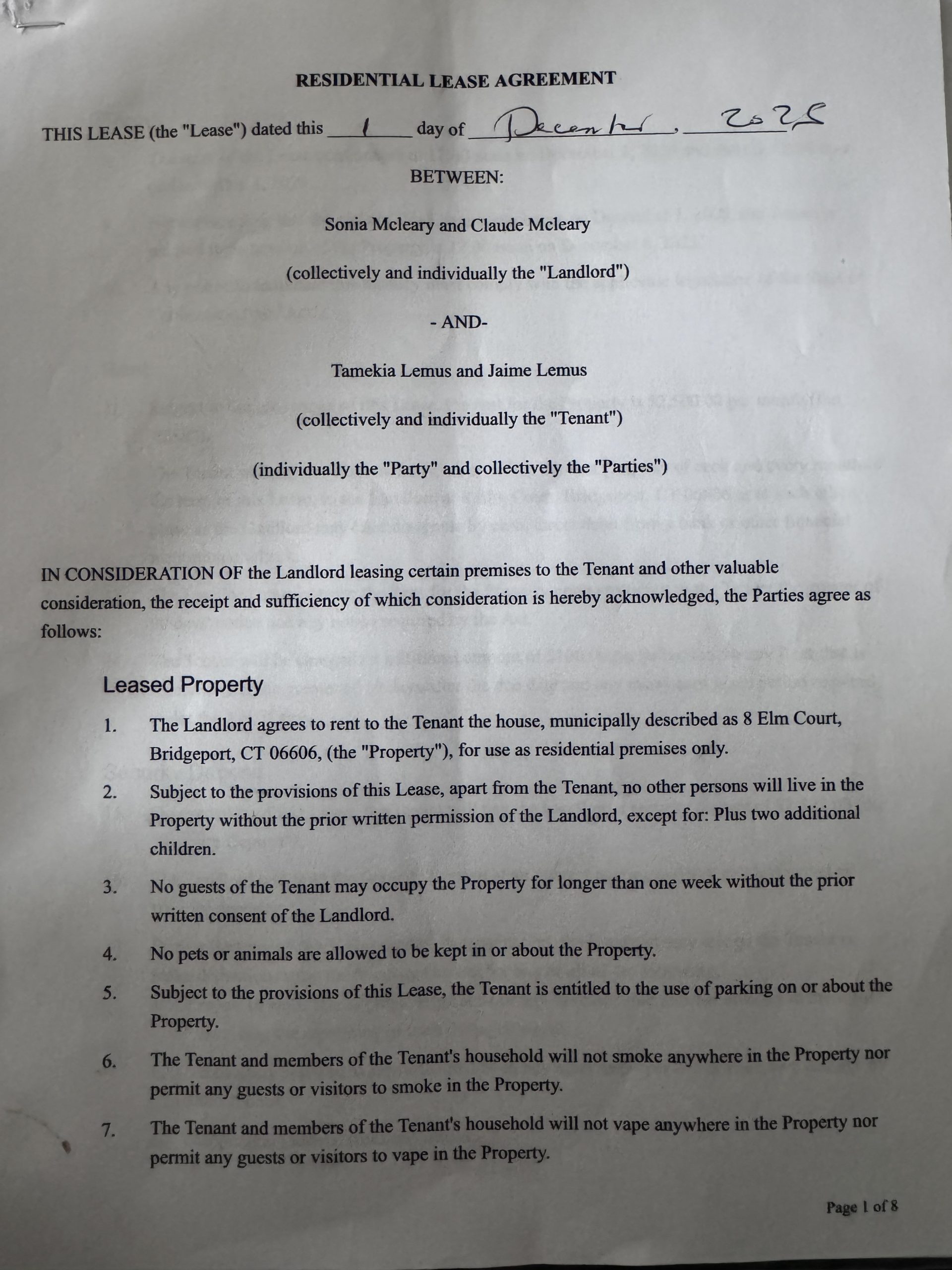
When Tamekia Lemus moved her and her family into their new apartment at 8 Elm Court in Bridgeport, she was an active member of the Bridgeport community; for seven years, she has run her own business selling handcrafted goods, and in 2024, she began participating in Bridgeport’s First Thursday Fiesta, a monthly pop-up shop held at the City Government Center meant to promote and support local small business owners.
“That’s how I ended up meeting the majority of everybody there, the mayor, the deputy mayor,” said Lemus. “I have sold stuff — and my husband can verify — to the majority of everybody in that building. They know me.”
Additionally, Lemus has been an active volunteer, having founded a charity organization called Girls With a Crown United. It was through her active participation in the community that she found her new apartment. Lemus met Kadie Ortiz, the wife of Bridgeport City Councilman Richard Ortiz and a Special Projects Coordinator for Bridgeport’s Small and Minority Business Enterprise, introduced her to Sonia McLeary, the apartment’s landlord. Ortiz even notarized their lease agreement.
“I really enjoyed living in Bridgeport,” said Jaime Lemus, Tamekia’s husband. “To live in this apartment we rented — it was beautiful.”
It was also short-lived. After investigating a complaint, the Bridgeport Building Department found the McLearys had made numerous unpermitted renovations to their home and were operating an illegal apartment, which forced the Lemuses to relocate.
Now, months after being made to leave, the Lemus family has been left alone to pick up the pieces. They say city officials have given them conflicting information, offered no assistance, and allegedly never informed her of her rights under the state’s Uniform Relocations Assistance Act, a decades-old law meant to help displaced tenants.
As a result, Lemus has experienced distress and financial hardship, and has had to put her small business on hold and find additional work to make ends meet. Their family has been living in an extended-stay hotel in Shelton.
Lemus feels betrayed by the city officials she once saw as friends and is disillusioned with the state of Connecticut. As a result of the fiasco, her husband requested a transfer from his employer, and the family will be relocating to Florida in early July.
“I was very hurt, I’m not gonna lie to you, because they kind of just turned us away,” said Lemus. “Why stay here if they’re going to do us like this, and all the rest of the people like this? Why stay here and support this state?”

Lemus’s Relocation Story
Tamekia Lemus moved into her old apartment on Dec. 11, 2025. Before the move, she lived in the City Trust apartments in downtown Bridgeport, but after surviving an aneurysm, the apartments’ frequent marijuana odor would give her crippling migraines.
“I spent a lot of time at City Trust in bed,” said Lemus. “So after going back and forth with the property managers there, we decided not to renew our lease, and we started looking for somewhere more secluded.”
Lemus lived in the Elm Court apartment for just over three months before a knock on her door turned her and her family’s lives upside down.
“April 1 [2026] is when we get a knock on our door, and it was Frank [D’Andrea] from the Bridgeport building department, and he asked us if we were tenants,” said Lemus. “I said, ‘Yes. We’re tenants.’”
D’Andrea asked Lemus if he could come in, which she obliged. He looked around, then asked how much she paid; $2,500 a month for rent and utilities, Lemus told him. D’Andrea then asked Lemus if her landlord was present.
“I said, ‘Well, I think the wife is at work, but the husband is here, he’s downstairs,’” said Lemus. “Literally, as soon as I said that, he [Claude] knocked on the door.”
When she opened the door, Claude immediately asked her who the City of Bridgeport car belonged to. Lemus explained someone from the city was there, and D’Andrea introduced himself to Claude. As the two walked and talked their way to the downstairs unit, Lemus and her husband questioned the significance of the encounter.
“Me and my husband were looking like, ‘Okay, what’s going on?’” said Lemus. “So I told my husband, ‘I’ll put on my shoes, you put on yours, and let’s go down to find out if everything’s OK.’”
By the time she crept halfway down the stairs to her landlord’s unit, Lemus recalled hearing Sonia’s voice coming through the speaker of Claude’s phone.
“She was telling D’Andrea, ‘No, no, no, we don’t have tenants here, that’s my cousin, she lives upstairs with her family,’” said Lemus.
Jaime couldn’t believe what Lemus had heard when she told him. The two continued to listen in on the conversation downstairs; D’Andrea told Sonia that the cat was already out of the bag and that she was running an illegal apartment unit, while Sonia pushed back, claiming she had a permit. Lemus returned to Claude to ask, “Is everything OK?” receiving only a shrug and a head shake in return. When she saw D’Andrea leaving, Lemus said she “got scared” and decided to call the number he had left her to ask if there was anything she and her husband needed to know. D’Andrea told her that he would call them back.

The next day D’Andrea told them that they would have to leave the apartment. Lemus then called the city’s Zoning Department, which told her the neighborhood she lived in was zoned for “single-family homes only,” and that only family members could live in the home, not paying tenants.
Lemus next met with a “Mr. Earl,” from the city’s Department of Social Services, who told her that they should try to “work something out” with the McLearys to see if they could stay.
“So we did, that Saturday before Easter [April 4], and that’s when she [Sonia] again told us that she didn’t know what we were talking about,” said Lemus. “She went up to the building department’s office and spoke to the supervisor, Mr. Sean [Masi]. He told me, that she told him, that I was a distraught family member and me and her had bad blood, and I was doing this to her.”
At that point, it was clear to Lemus that Earl’s plan to “work something out” was not going to happen. The same day, a building inspector came by to give official notice that the apartment would be condemned. Lemus said she left soon after and headed to the Building Department to speak to Masi.
“I didn’t want to be there, to be honest with you,” said Lemus. “I didn’t want to be there because I don’t want to get upset. I’m not the type of person that’s rowdy, and I didn’t — I was just freaking out, scared.”
At his office, Masi confirmed to her that the apartment was illegal and that the downstairs unit was not approved for habitation. On Zillow, Masi explained, the whole house, not a subunit, was listed for rent. While the renovated house had six bedrooms, it was listed online as a three-bedroom. The same could be seen on Lemus’s lease, a copy of which she provided Inside Investigator.
On April 6, Lemus returned to the apartment with a termination of lease, a document stating her intent to break the terms of the lease she signed with McLeary. Lemus said someone from the City’s Housing Court told her on the 3rd to leave before her rent was due on the 10th, or the McLearys “could possibly try to evict you,” for not paying that month’s rent. At that time, Lemus said that both a representative of the City’s Housing Department and D’Andrea had told her she would need to leave due to the unpermitted work.
“So I gave this to them on the 6th, we moved out officially on the 9th, we went back in and cleaned everything up on the 10th,” said Lemus.
Both Lemus and her husband asked the McLearys to conduct an official walkthrough while preparing to move out; Lemus received no response from Sonia, but Claude told Jaime to leave the key under the rug when they were finished leaving. Lemus took photos and videos of the unit, and a video of them placing the key under the rug, but the McLearys failed to return their security deposit.
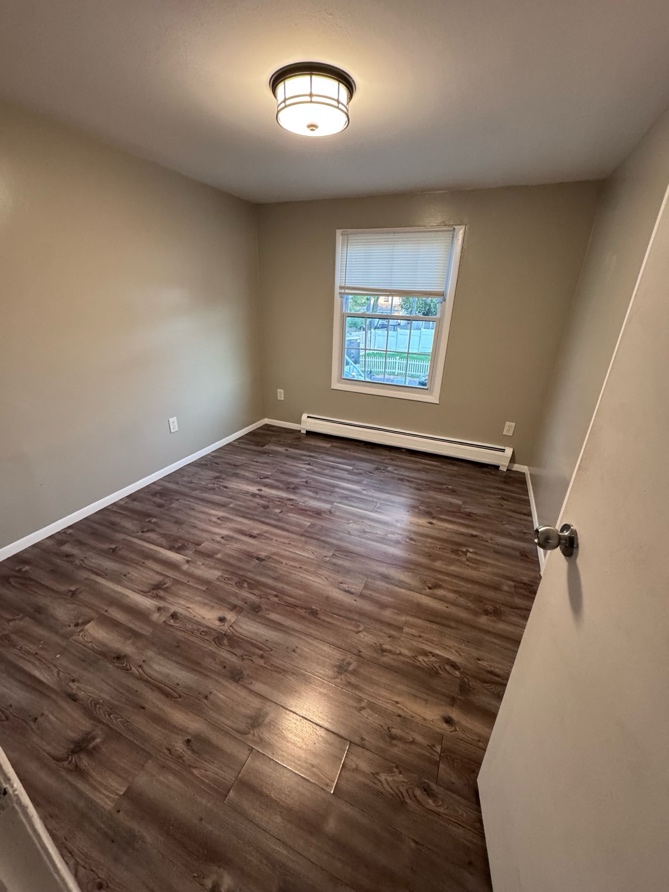
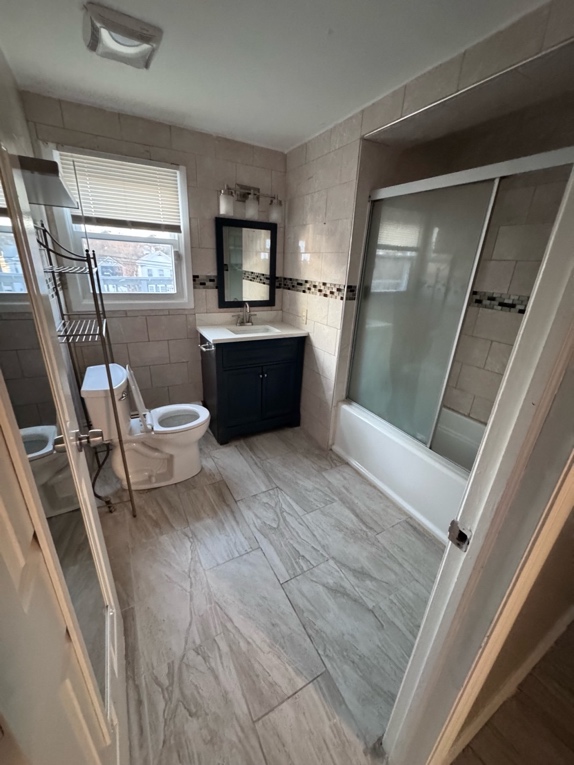
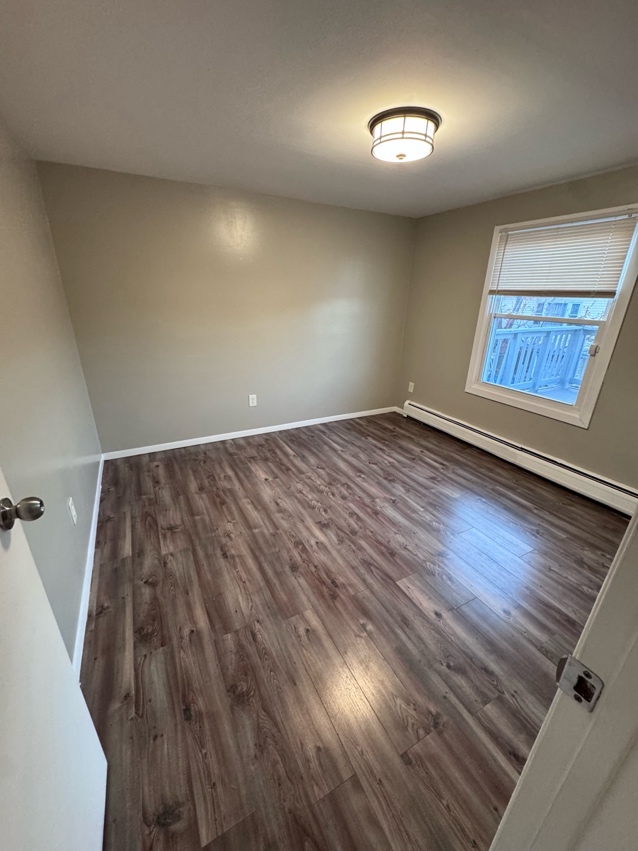
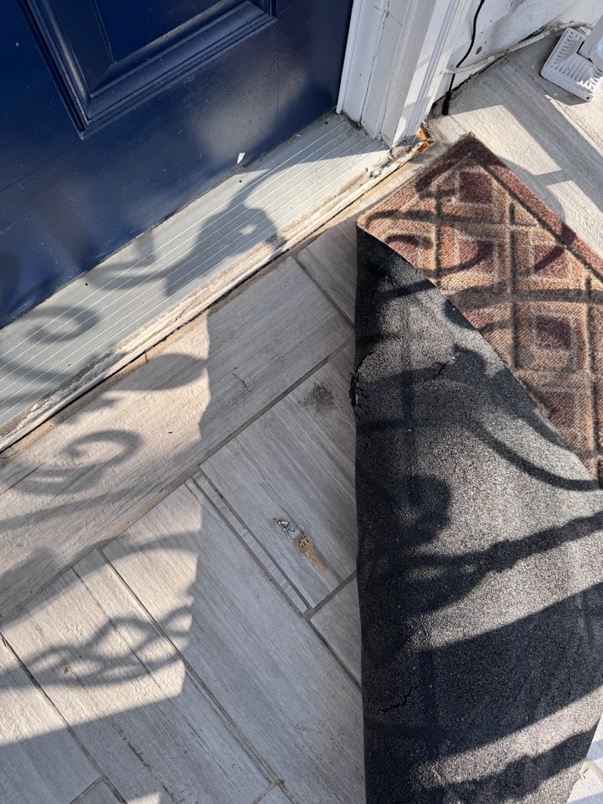
“We did nothing to their property,” said Lemus. “We left it, actually, better than it was given to us. She’s telling people that we never left her key!”
Since leaving on April 10, Lemus has been living at an extended-stay hotel in Shelton. When she spoke to Jennifer at Bridgeport’s Social Services to ask for assistance, Lemus says she was directed to contact the city’s Fair Rent Commission instead.
“Fair Rent called the landlord [Sonia], and the landlord told the lady at Fair Rent that we didn’t pay her, that we never paid her for any of the months,” said Lemus. “They said they can’t help us.”
Lemus provided Inside Investigator with photos of receipts for all the times she paid the McLearys. She said that McLeary preferred cash or Zelle over checks and insisted they leave the memo section blank on any payment they made.
After trying and failing to get in contact with Nadine Douglas, Bridgeport’s City Social Worker at that time, Lemus said she ran into her at the Shelton Walmart. Lemus, who said that “everybody knows everybody” in Bridgeport City Hall, said that Douglas acted as though she didn’t recognize Lemus’s number.
“I know her, because my business does a lot of business in the government center,” said Lemus. “I said, ‘I’ve been trying to contact you,’ and she said, ‘Oh, I didn’t know who you were,’ but she did know who I was! I’m saved in her phone.”
When Lemus explained the situation, Douglas told her that the issue was that she “moved out before the city could move you out.”
“I was like, ‘What do you mean?’” said Lemus. “They told me I had to move out! And then she said, ‘Well, technically, you were supposed to wait until the city came in and moved you out.’”

Uniform Relocation Assistance Act
In 1971, the Connecticut General Assembly passed the Uniform Relocation Assistance Act (URAA), following the federal URAA law, which had passed a year prior. URAA mandates that municipalities and state agencies must provide financial assistance to those displaced by municipal or state actions, such as property acquisitions, voluntary rehabilitation of buildings under state supervision, or building code enforcement activities. Displaced tenants under URAA are eligible to receive compensation for relocation costs, as well as up to $4,000 to cover rent at a new place, with the caveat that tenants must match any assistance over $2,000.
Lemus, a tenant who was displaced due to municipal building code enforcement activities, is exactly who this bill was made to assist. Unfortunately, as Douglas told her at Walmart, and as Luke Melonakos of the CT Tenants Union agreed, she was disqualified the second she moved out.
“The real breakdown here is the building official telling her to move out, instead of telling her her rights to the Uniform Relocations Assistance Act,” said Melonakos. “So, to me, that’s the core problem here, is that building official’s action.”
Melonakos explained that in situations such as Lemus’s, municipal officials are supposed to front the displaced tenant the money necessary to cover relocation costs and then stick the landlord with the final bill. If the landlord refuses to pay the municipality, URAA gives municipalities the right to take the landlord to court to compel payment and place liens on their property.
Lemus did not receive URAA assistance because, in the eyes of the law, she was not technically a “displaced person.” URAA defines a “displaced person” as anyone who moves “as the result of the written order of the acquiring agency or unit of local government,” or “any person who so moves as the direct result of code enforcement activities.” Because Lemus was deemed to have left before a written order to vacate was officially issued, she was not technically qualified as a “displaced person.” Lemus was never made aware of her URAA rights and did not know the law existed until Inside Investigator informed her.
“They never told us they weren’t going to help us financially because we left,” said Lemus. “The first reason they gave us was because they already helped us before, when my husband got fired from Dollar General in 2025. Fair Rent helped us with our rent.”
Nowhere in the City of Bridgeport’s municipal ordinances is a limit imposed on how often a tenant can file a complaint with the Fair Rent Commission. Regardless, the job of a Fair Rent Commission is to review complaints regarding excessive rent increases or housing discrimination, not to provide displaced residents with wraparound services; that’s the job of the Social Services Department.
Essentially, Lemus operated on limited information and, at times, blatant misinformation given to her by numerous city officials from various departments. She stressed that she wasn’t looking for financial assistance, just guidance on what to do next, and admitted to feeling so lost and misguided by city officials during the process that she, “got more guidance from Chat GPT than I did from people who I’ve known for years here!”
Lemus asked Building Department officials to see the citation issued to the McLearys and was told she had to FOIA for it. She received it weeks later, after she had already left the apartment. McLeary provided a copy of the citation’s case report, which confirmed what building department officials had already told her: the property was being cited for housing an illegal apartment, unpermitted exterior work and permit issues, and a stop work order had been placed. What surprised Lemus was the last sentence of the report, under the ‘resolution’ section.
“After speaking with the homeowner, they will be going through the process to make all improvements permitted,” reads the report. “I also spoke with the Tenant who decided on her own to leave, she stated that she was moving down south.”
It is unclear on what date the document was authored and put on file; no one from the Bridgeport Building Department responded when Inside Investigator asked. Lemus said that D’Andrea first told her on April 3 that she would have to leave the apartment, and that she didn’t tell him her intent to leave until the 10th.
Inside Investigator FOIA’ed Bridgeport’s Building Department for “any written orders to vacate, emergency or hazard orders, or notice of code or building violations,” issued for the property from April 1 to April 15. Notably, Building Department officials did not provide any copy of a written order to vacate, nor did the Building Department respond to Inside Investigator’s inquiries as to whether its absence indicated that such an order was never issued. Instead, they provided Inside Investigator with the same case report given to Lemus.
Whether the Building Department deliberately instructed Lemus to leave without informing her of her rights or did so unknowingly, the result is the same; she and her family have had to relocate and pay all the associated costs without assistance, and she has had to take the McLearys to housing court herself.
Inside Investigator requested to speak with officials from the City’s Building Department and Fair Rent Commission, but received no comment. When attempting to contact Nadine Douglas, Inside Investigator was informed by Dr. Elizabeth Rivera-Rodriguez, Bridgeport’s Director of Health and Public Services, that Douglas no longer worked for the city. Upon further inquiry, Rivera-Rodriguez did not inform Inside Investigator of whom to speak to regarding the city’s handling of displaced residents.

Reluctant Enforcement
Despite URAA having been on the books for decades, Melonakos said that municipalities often display a “reluctance” to use it.
“This is the case for a lot of tenant rights issues at the municipal level,” explained Melonakos. “It’s a problem of the city not doing their job.”
Melonakos said that the CT Tenants Union has worked on URAA issues primarily in Hartford, as it’s had “so many fires, especially in the past couple of years.” In January, Hartford’s Fire Chief Rodney Barco reportedly said that fires displaced 980 people in 2024 and 2025. As burnt-out apartments are officially condemned, tenants are qualified for URAA relief.
There have been thousands of instances of Hartford ignoring or delaying assistance to displaced tenants; in 2016, the city settled for $2.75 million in Serrano v. Gaitor, a class-action suit originally filed in 1981 by four tenants displaced by a fire who did not receive URAA assistance. The settlement was paid out to nearly 4,000 Hartford residents who were improperly assisted from 2010 to 2015. While the CT Tenants Union has worked primarily in Hartford, Melonakos said Bridgeport has also suffered from similar issues in recent years.
“Hartford and Bridgeport have definitely struggled massively to enforce this law,” said Melonakos.
While Hartford city attorneys argued in Serrano v. Gaitor that URAA represents just another unfunded mandate imposed upon municipalities by the state, Melonakos argued that it isn’t an issue of finances, but rather a lack of willpower.
“The law allows them to recoup the money from the landlord; they just need the will to do that,” said Melonakos.
On the other hand, Melonakos acknowledged that successful enforcement also requires “case management and social services capacity,” which varies from city to city. He credited the cities of East Hartford and New Haven for working with the CT Tenants Union to address the shortcomings in their relocation procedures and said the significant improvements made by both cities did not require ballooning budgets.
“Most of the reforms that needed to be made were mostly administrative; it wasn’t that a bunch of new money needed to be pumped into anything, it was just people needed to be trained in those positions,” said Melonakos. “There needs to be a clear protocol of what happens when different types of displacement situations occur, and it just took the mayor paying attention to the program and straightening it out administratively, and that ended up making a huge difference in terms of tenant experiences.”
Melonakos said that in Hartford, poor communication with displaced tenants was a common issue.
“When we were dealing with this in Hartford, the communication from the city was so unclear, so delayed; they did get in touch with tenants eventually, but it took three weeks,” said Melonakos. “It was really poor communication, and people were getting really confusing information about what they were entitled to, so that’s a huge problem.”
Even if assistance is provided to displaced tenants, Melonakos believes it is insufficient given the rising cost of housing. URAA stipulates that displaced tenants be provided, “the amount necessary to enable such displaced person to lease or rent for a period not to exceed four years,” but “not to exceed four thousand dollars.”
According to the US Census Bureau, the median rent in Connecticut in 1970 was $127; if a displaced tenant received $4,000 at the time, they could feasibly expect to cover a little over two and a half years of rent. As URAA stipulates that tenants must match any financial assistance over $2,000, tenants who received a full $4,000 worth of assistance must put up an additional $2,000 of their own money; $6,000 in 1970 could feasibly have covered 47 months, just under four years’ worth of rent. As of 2026, Apartments.com reports the average cost of a 1-bedroom apartment rental in Connecticut is $1,902 per month. Today, $2,000 can cover one month’s cost of the average apartment, and $6,000 could cover three.
Melonakos said that an increase in financial compensation was “a demand early on during our fight with the city of Hartford over the Concord Hills displacement.” After a fire at the Concord Hills apartment complex displaced 105 residents in August 2024, the City of Hartford put displaced families up in a hotel until January 2025. Melonakos acknowledged that he does “think the state would need to help fund” an increase in rental assistance, but ultimately sees amending the legislation as secondary to ensuring cities enforce it in the first place.
“The law is a dead letter unless the government actually uses it,” said Melonakos. “A lot of our organizing and activism has had to be just pressuring cities to do what they’re supposed to do under the law. We haven’t really been pursuing legislative avenues for it, because the law that’s on the books is pretty good, it’s just not being used.”

The Impact
Lemus and her family have been financially, professionally and mentally devastated by their dislocation.
“I was scared,” said Lemus. “I actually thought we were going to be homeless.”
Lemus has six daughters and one son from previous relationships, and a 15-year-old stepdaughter, Isabella, through her husband. Before they had to move, Tamekia and Jaime lived with Dominique, Tamekia’s youngest daughter, who is 20 and has special needs, as well as Isabella. But when they were forced to relocate, they sent Dominique and Isabella to temporarily live with one of her older daughters, Kenya, because of the lack of space at the hotel.
“We couldn’t afford a bigger room at the extended stay to accommodate all four of us,” said Lemus. “The girls would have had to have stayed in a small space with two adults. They were used to their own space, so Kenya had space to help with making the situation a little more manageable.”
Kenya also lives in Bridgeport, which helped ensure the kids could continue going to school without any disruption. Lemus communicated with the school district to figure out busing and buy a couple of air mattresses for her kids to sleep on, before they eventually reunited. Lemus said the move has been just as disruptive to their routines as it has her and Jaime’s.
“The effect of the relocation has been very hard,” said Lemus. “Dominique, my 20-year-old, is autistic and special needs. Change is a big adjustment for her, and we wanted her to feel safe, as well as Isabella, who is used to Jaime and I keeping her safe.”
The relocation has stretched both Lemus and Jaime thin financially.
“More gas to get the girls back and forth [to school], sometimes not having enough to eat and having to eat smaller portions because we didn’t have the extra money to buy a lot of food,” said Lemus. “Dominique is graduating and it’s been very hard trying to get her all the things she needs.”
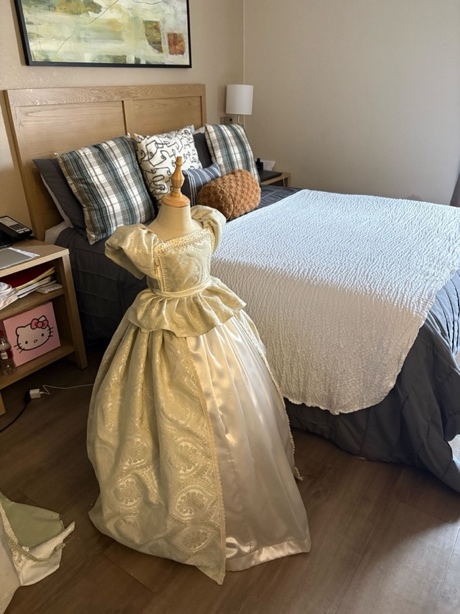
For seven years, Lemus has run her own business out of her home, sewing and selling dresses, tote bags, and cosmetic bags, as well as crafting and selling miniature doll houses, key chains, wreaths, and other items made via laser cutter. Jaime, who works as an AMC Manager in Norwalk, also started a side business a year ago, making tattoo balms, beard oil, candles, cigar boxes, and air and car fresheners.
While Jaime has been able to keep working at AMC, neither has the space in their hotel rooms to continue making goods for sale. When Inside Investigator met with Lemus, she had two sewing machines in her hotel room and was working on two dresses. She said she no longer could afford to purchase new materials and was “kind of working with stuff I already had.”

“I made these dresses yesterday,” said Lemus. “I’m gonna try to finish on them, post them, and see if I can sell them.”
Lemus said she has started working as an Amazon delivery driver in the mornings and as a retail merchandiser for CVS in the afternoons. She had to put her laser cutter, “a $2,000 machine,” as well as other larger belongings and tools of her and her husband’s trade, into storage. All in all, they are paying $214 a month in storage costs. As for the hotel, she spent $611 per week in April and will have to spend $744 per week in May due to peak-season pricing. Essentially, the two saw their rent rise from $2,500 per month to $3,296.23 per month from May onwards.
“You know, my whole check goes to this hotel biweekly,” said Jaime. “I don’t mind it: at least I have a roof over my head, I have food in my house, I’m happy. I’m taking care of my wife, I’m taking care of the kids, and I’m happy with it. But at the end of the day, you know, we wasted four months giving up almost $12,000 to a person who was not real to us. She asked us to be real with her, and we did; We opened up our hearts, and we were real to her. We opened up, and what we got in return was a backstab, and that’s what hurts the most for me.”
Lemus also felt betrayed, not only by the McLearys, whom she said developed a close relationship with her family, but also by Bridgeport’s city officials.
“They know me,” said Lemus. “They know that I would never do anything to jeopardize my living arrangements.”
Over the duration of her stay at 8 Elm Court, Lemus said her and McLeary’s relationship grew to be “more than just the connection of a landlord and tenant.” McLeary told Lemus it was a “blessing from God” that she found her as a tenant when they first signed their lease, said Lemus. McLeary even bought a TV for Lemus’s daughters after hearing about the stress Lemus’s recent health issues had wrought on her family’s finances, said Lemus, a TV which she left at the apartment when moving out.
“We had started to be friends with them,” said Lemus. “They invited us to their home; I made a gingerbread outfit for their granddaughter to wear to Christmas. We were just giving each other things to say how grateful we were. So, to hear somebody lie on you like that, it’s hurtful, especially when you don’t open your heart up to a lot of people.”
Lemus said that she was “literally livid” when she first heard McLeary lie about her status as a tenant to D’Andrea.
“When she lied on me, I blocked her from even calling my phone,” said Lemus. “I don’t like liars; I don’t deal with them.”

What’s Next?
Melonakos said that because Lemus’s struggles are “a problem of the city not doing its job,” she should “make sure the mayor and city council know about it.” While Lemus first told Inside Investigator that she was hesitant to get the Mayor’s Office involved, she did say she had reached out to Jorge Cruz, her former City Councilman, several times to no avail.
“I sent [him] pictures, everything he wanted to know,” said Lemus. “I told him about the other families here. He told me he’s gonna call me back. I haven’t heard back from him.”
In their initial conversation, Cruz told Lemus he spoke to Councilman Ortiz about the issue, and Lemus said, “they were supposed to work together to get my deposit back, but I never heard from him again.”
On June 1st, Lemus testified publicly before the Bridgeport City Council. She shared her own experiences before telling the council about the “six other families facing similar circumstances,” whom she has since met living at the hotel in Shelton. Lemus stressed the fact that it’s “not just a housing issue, it’s a public safety issue.”
“When apartments are created without permits or inspections, tenants have no way of knowing whether electrical work, plumbing, fire safety systems and occupancy requirements meet legal standards,” said Lemus. “Families are placed at risk and when violations are discovered, it’s often the tenants who suffer the consequences.”
Lemus then shared with the council that her family has “made the difficult decision to leave Bridgeport,” and called on the council to prioritize the issue moving forward so that other families can be spared the struggles hers experienced.
“I’m asking that the council strengthen the enforcement of existing laws regarding illegal apartments and unpermitted residential constructions, improve accountability for landlords who violate these laws, and ensure that the tenants who unknowingly rent illegal units are not left without support when these situations arise,” said Lemus. “I respectfully ask you to make this issue a priority before more families find themselves in the same position. I have loved Bridgeport. I have grown. I will miss you all. And thank you kindly for listening.”
Councilwoman Dasha Spell was “the only person that came up to me” after the public hearing, said Lemus. Lemus said that Spell asked her to hand out the councilwoman’s card to anyone else at the hotel who needed assistance, and that she also asked for information regarding which city officials Lemus spoke to and when. Outside of Spell’s interest in the matter, Lemus said, “No one has said anything at all.”
Since city officials have thus far failed to help her, Lemus has taken it upon herself to take McLeary to Housing Court to fight for her security deposit. Lemus said a lawyer informed her that, because the lease was illegal, she could potentially get all of her rent reimbursed in addition to compelling the McLearys to cover her relocation costs, but that it would require her to take the case to Superior Court, as in Small Claims Court, her awards are capped at $5,000.
“I’m not trying to do the story at all for monetary purposes,” said Lemus. “I’m doing this because she [McLeary] illegally did something. She knew she illegally did it. And this is not just a regular lease that four people signed; this was actually notarized by the councilman’s wife!”
While Lemus originally told Inside Investigator that she was content to keep the issue in Small Claims, on June 1, McLeary herself filed a motion to transfer the case to Superior Court. McLeary indicated her reason for doing so was to raise “a counterclaim in an amount greater than the jurisdiction of the small claims court.”
“The Plaintiffs had a written lease agreement with me for a term of one year,” reads the motion. “The Plaintiffs terminated the lease without cause. There were and are no habitability deficiencies which would allow for the termination of the lease.”
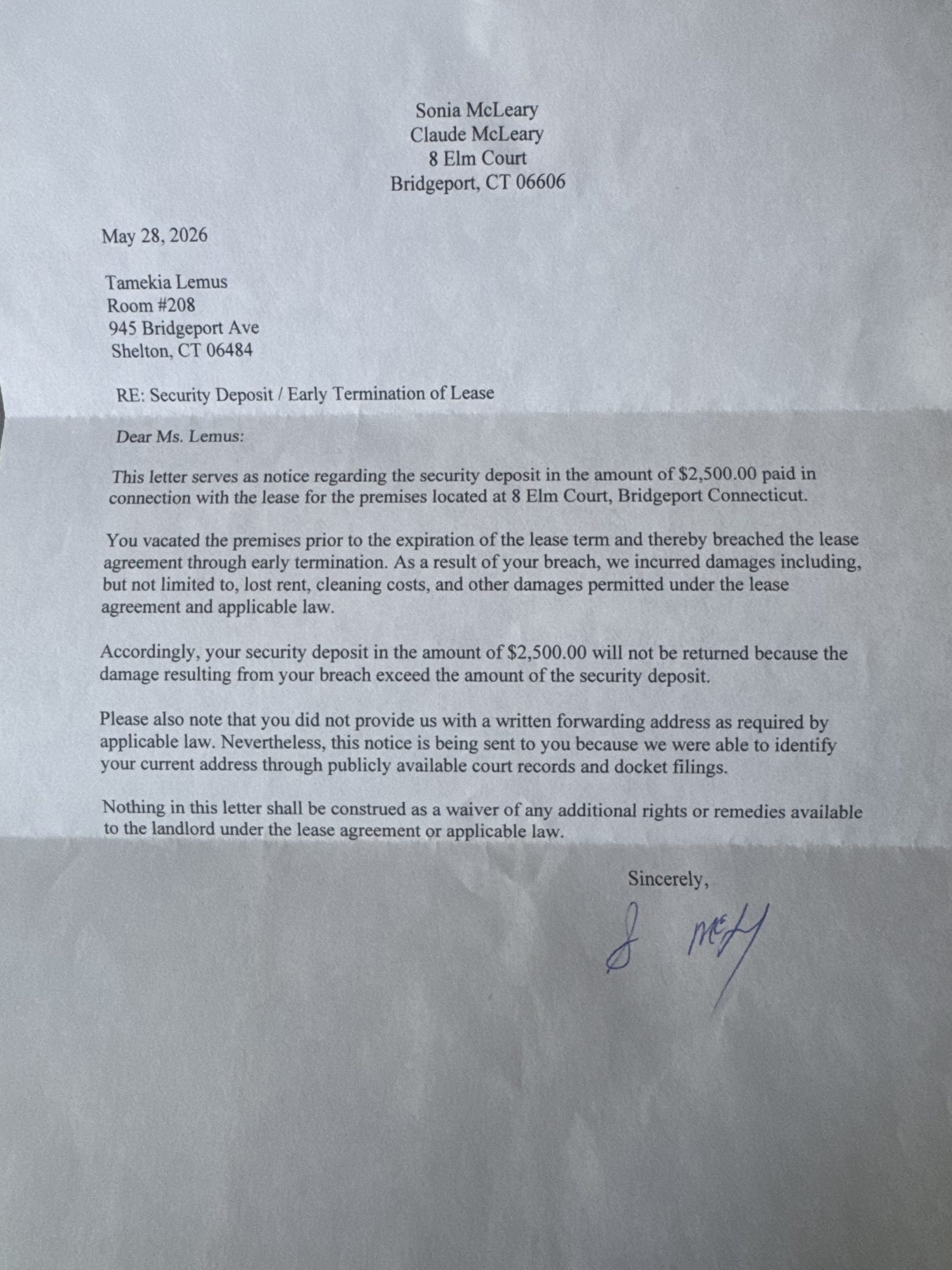
McLeary goes on to claim that a building official told her there “was no health or safety risk,” that the unit did not require a CO because it is “owner-occupied and contains three or less housing units,” and that McLeary had never sent over a security deposit because Lemus “never provided written notice of a forwarding address.” Instead of her security deposit, Lemus recently received a letter from McLeary in the mail.
“You vacated the premises prior to the expiration of the lease term and thereby breached the lease agreement through early termination,” wrote McLeary. As a result of your breach, we incurred damages including, but not limited to, lost rent, cleaning costs, and other damages permitted under the lease agreement and applicable law. Accordingly, your security deposit in the amount of $2,500.00 will not be returned because the damage resulting from your breach exceed the amount of the security deposit.”
Lemus could not believe McLeary’s decision to transfer the case. Inside Investigator called and left a voicemail for McLeary, but she never responded.
“I’m assuming she’s trying to scare me,” said Lemus of the motion. “We’ll fight for the whole $15,000 if she wants to go there.”
Because of her own displacement struggles and those of the other families in her hotel, Lemus said her eyes have been opened to how often tenants are left to fend for themselves, and that she hopes this story will inform future displaced tenants of their rights and change the way Bridgeport interacts with them.
“I hope that one day the city of Bridgeport can open up an advocacy for people, not just for landlords but for tenants too, and help guide them,” said Lemus. “Why are there no advocates for this? Why is nobody talking about this? It seems like nobody talks about it, and I don’t understand why.”
Was this article helpful?